Sammlungen

Highlighting a ‘Forgotten’ Perspective on the First World War: German POWs in Japan and the Bandō-Sammlung

Gastbeitrag von Prof. Sarah Panzer

The staggering quantity of literature on the First World War can give rise to the mistaken impression that scholars have already said all that there is to say on the topic, especially in the wake of the many fine publications which emerged out of the centenary commemorations of the conflict. Growing recent interest in the conflict’s global dimensions, as well as the diverse experiences of captivity and internment faced by military prisoners and civilians alike, however, have illuminated new directions for scholars to pursue. Even within this literature, the East Asian front of the First World War has been largely relegated to the status of a historical footnote, a function both of its geographic distance and its brevity, at least militarily.

On 23 August 1914, Japan declared war on Imperial Germany, using its alliance with Great Britain as a convenient pretext in claiming Germany’s colonial possessions in Asia for its own. By mid-October the Japanese Navy successfully occupied German Micronesia and on 7 November the German garrison at Tsingtao (Qingdao) surrendered to the 18th Infantry Division of the Japanese Imperial Army, supported by a symbolic contingent of British troops. The nearly 4,700 German and Austrian servicemen captured at Tsingtao were subsequently transported to the Japanese mainland, where they were housed in a series of temporary camps throughout central Japan. Once it became clear that the war would not be ending as quickly as initially predicted, these camps were replaced by larger, more comfortable facilities intended to mitigate the prisoners’ boredom and loneliness.

Repatriation of the POWs only began in 1919, with the final prisoners returning to Germany (excepting those who chose to remain in Asia) in 1920. Over the course of their five-year captivity, these men produced a significant archival record of their lives in Japan, including camp newspapers, printed objects such as concert programs and postcards, personal diaries and memoirs, and dozens of photographs. The Bandō-Sammlung, held since late 2021 in the Ostasienabteilung of the SBB-PK, sheds invaluable light on a dimension of that conflict which has been so far largely overlooked by researchers outside of Japan.

The Best Camp in the World

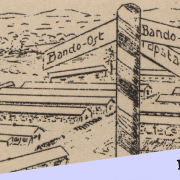
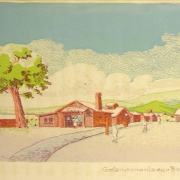
Camp Bandō was one of the ‘second generation’ camps opened during the war; it opened in early April 1917 and was officially closed three years later, on 1 April 1920. Located on the island of Shikoku and built to accommodate the prisoners previously held in the camps in Matsuyama, Marugame, and Tokushima, Bandō quickly acquired a reputation as a model camp because of its many well-resourced facilities and opportunities for cultural and social diversion. The camp included living quarters, administrative buildings, kitchens, and baths, as well as two small lakes (one of which was used by the prisoners for boating) and a small ‘commercial district’ with some eighty shops, specializing in everything from bookbinding and photography to furniture construction and musical instrument repair. (Fig. 1) Just outside the camp the prisoners also had access to a large sports complex, which boasted a soccer field, a Turnhalle, and eight tennis courts.
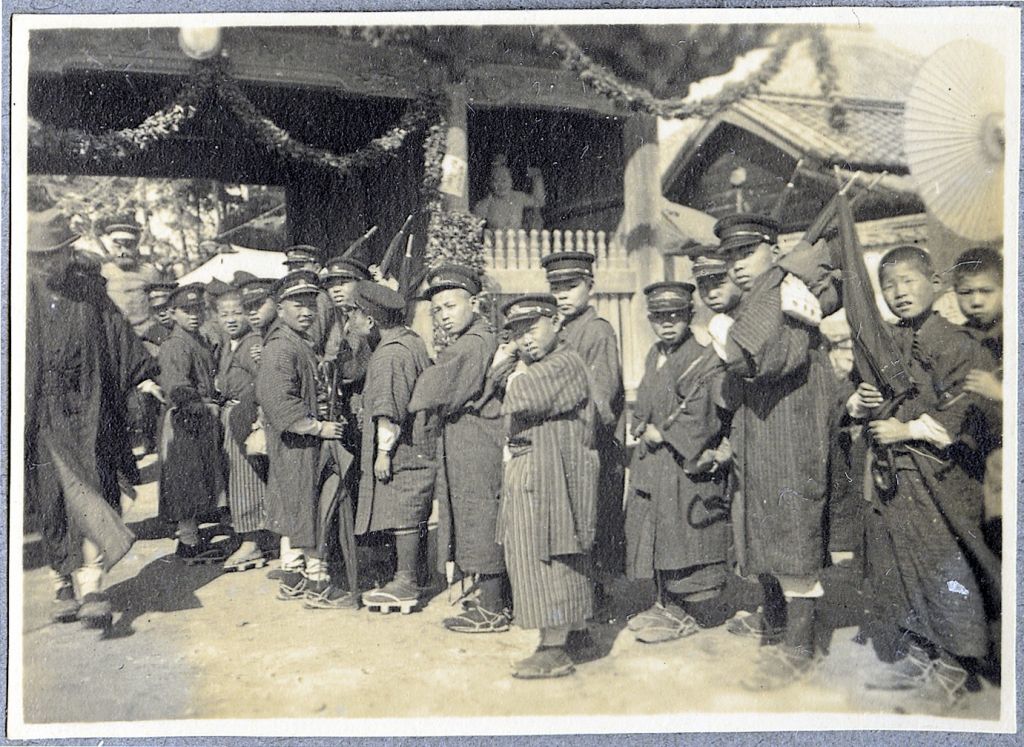
Fig. 2: A group of students waits in line to enter the exhibition of “visual arts and handicrafts” organized by the residents of Bandō POW camp. The exhibition was hosted by the nearby Ryōzenji temple, hence the statue in the center of the image. A no less imposing bearded German soldier is visible on the lefthand side of the photo. SBB-PK. Bandō-Sammlung H 57-07.

Fig. 2: A group of students waits in line to enter the exhibition of “visual arts and handicrafts” organized by the residents of Bandō POW camp. The exhibition was hosted by the nearby Ryōzenji temple, hence the statue in the center of the image. A no less imposing bearded German soldier is visible on the lefthand side of the photo. SBB-PK. Bandō-Sammlung H 57-07.

Even at the time, prisoners referred to Bandō as the “best camp in the world,” and both the camp and its commander—Lieutenant Colonel Toyohisa Matsue—have become synonymous in contemporary popular memory in Japan with a humane and tolerant approach to internment, which facilitated not only a (relatively) pleasant experience for the prisoners themselves, but also a mutually beneficial circuit of cultural and intellectual exchange between the German prisoners and their Japanese neighbors. One striking example was the exhibition of “visual arts and handicrafts” organized by Bandō’s residents in March 1918. Visitors could peruse the works on display—which included everything from oil paintings to technical models to taxidermied local birds—at their leisure or receive a guided tour by a prisoner-translator, visit one of the concession stands and sample ‘authentic’ German baked goods, try their luck at one of the carnival games operated by the prisoners outside, or simply relax and listen to music performed by one of the camp’s multiple ensembles. (Fig. 2) With a reported total attendance of just over 50,000 visitors over twelve days, Bandō’s camp newspaper Die Baracke concluded that the exhibition had been a triumph of cultural diplomacy:

“Thousands of inhabitants of the country which holds us captive have admired the works of German POWs with their own eyes, and hundreds of thousands have heard about them through word of mouth and newspapers. To those who had been repeatedly exposed to the image of the German Barbarian since the beginning of the war, we were able to show them with our exhibit ‘Hie gut Deutschland alleweg!’—Thus, even with our modest resources, we were able to render a service to the Fatherland.”

(Die Baracke I, no. 25 [17 March 1918], 42. SBB-PK. Bandō-Sammlung A 2-1)

This quotation is a useful reminder that, their official status as POWs notwithstanding, the residents of Bandō saw themselves as participants in the ongoing global war. The activities and groups with which they occupied themselves were never simply about staying busy; they were also meant to project an image of German resilience, strength, and cultural superiority meant to function as ‘counter-programming’ to British and French propaganda.

Fighting Vicariously

The POWs held in Japan were avid consumers of news about the war’s progress, militarily and politically. Far from being isolated from the events back in Europe, prisoners were kept up-to-date through regular telegram transmissions—in the case of Bandō, these transmissions were recorded daily and made available to the camp’s residents through a subscription-based bulletin—from New York, London, Paris, and Moscow. German-language media was less consistently available, but newspapers, books and other printed materials shipped from Europe provided prisoners with an invaluable sense of connection to the German war effort. This ongoing interest in the war was, in one sense, eminently practical—although rumors of prisoner swaps or early parole persisted, most recognized that they were ‘stuck’ in Japan until the war ended—but it also speaks to the powerful sense of national unity and purpose which emerged in German-speaking Europe during the First World War.

Die Baracke featured monthly articles summarizing the major battles, personalities, and strategic developments on the war’s various fronts, as well as significant political events like the October Revolution in Russia. Likewise, President Woodrow Wilson’s public comments and speeches denouncing German autocracy and claiming that the US was fighting to secure a just and lasting peace for the peoples of the world, was met with scathing commentary in the pages of Die Baracke, with one article sarcastically responding, point-by-point, to Wilson’s rhetoric:

“‘America refuses to impose its will by exploiting the weakness and internal unrest of other countries.’
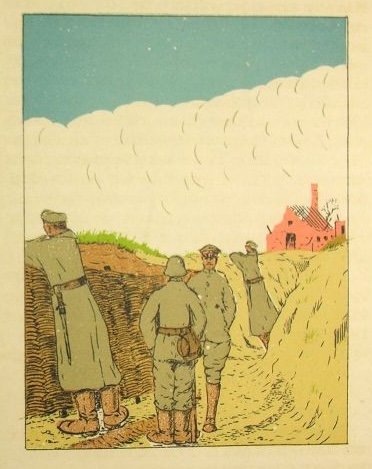
Fig. 3: Illustration of German trenches on the Western Front. The almost bucolic scene betrays the illustrator’s lack of familiarity with the realities of trench warfare. Drei Märchen von E. Behr. SBB-PK. Bandō-Sammlung B 06.

But you should not have said that Herr Professor… Mr. President! Or has your noble life’s work, the study and destruction of brutal German militarism, so completely occupied you that you have never heard of the Spanish-American War – it was in 1898? Your high-minded country has its own delicate American militarism, which was quite involved at the time ‘exploiting the weakness of other countries,’ to thank for the not quite so independent, rich island of Cuba and the likewise not entirely poor, not entirely independent Philippines.”

(Die Baracke I, no. 22 [24 February 1918], 13-14. SBB-PK. Bandō-Sammlung A 2-2)

On one level, these articles reflect the appetite for news about the war, in all its various dimensions, among the POWs in Japan; other articles published in Die Baracke, as well as public lectures in the camp, commented on modern military technology and tactics, specific battles, and the mobilization of the home front. Indeed, one of the more interesting artifacts of the Bandō-Sammlung is the lavishly illustrated book of modern German fairy tales published by the camp printing press in 1918; the first of the three stories takes place largely in the trenches of the Western Front, already an icon of contemporary cultural memory which neither the story’s author nor its illustrator had ever actually seen for themselves. (Fig. 3)

More meaningfully, however, they also demonstrate the intense emotional investment of the POWs with the German state, the German war effort, and with German war nationalism more generally. Kaiser Wilhelm II’s birthday was celebrated in the camp with lavish festivities, and tributes to the Prussian royal dynasty, Bismarck, and Field Marshal Paul von Hindenburg became a regular feature in Die Baracke. (Fig. 4)
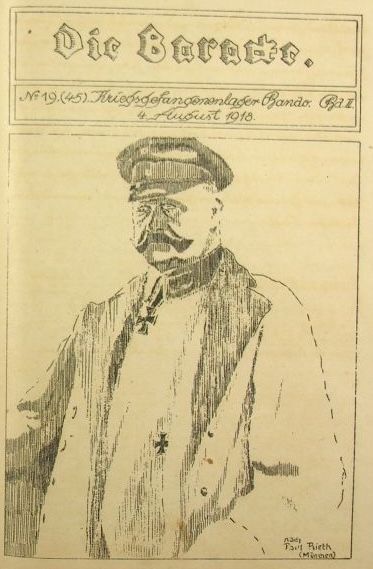
Fig. 4: A special cover of Die Baracke celebrating the hero of Tannenberg Field Marshal Paul von Hindenburg. By 1918 a veritable cult of personality had coalesced around Hindenburg in Germany, and apparently in Bandō as well. Die Baracke II, no. 19 (4 August 1918), 489. SBB-PK. Bandō-Sammlung A 2-2.

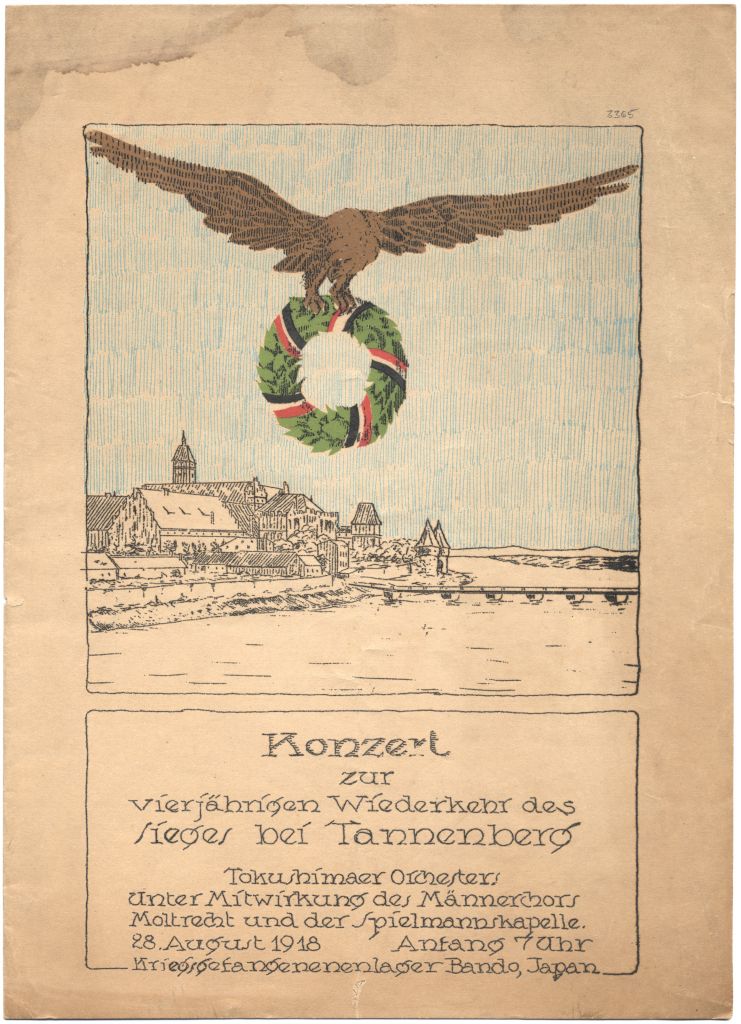
Notable battles from earlier in the war, such as the Battle of Tannenberg, were commemorated with special concerts. (Fig. 5) Nor were the residents of Bandō content to be mere observers, their circumstances notwithstanding; they (re)mobilized themselves as active participants in the war effort through fundraisers on behalf of their fellow German POWs in Siberia. It is not entirely surprising that the war would have been on the minds of these men; what is noteworthy, however, are the patterns revealed by their consumption of news and propaganda as an integral element of their performance as good and loyal Germans.
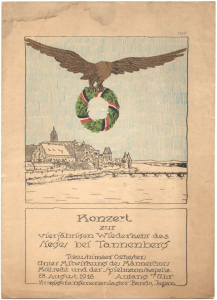
Fig. 5: Program for a concert by the Tokushimaer Orchestra in commemoration of the fifth anniversary of the Battle of Tannenberg. SBB-PK. Bandō-Sammlung E 3-17.

The German and Austrian POWs held in Japan during the First World War were determined to not be forgotten by their political leaders and fellow countrymen. Accordingly, they documented their lives in Japan, their thoughts on the war, and their feelings towards German culture and national identity in a variety of sources. This research was conducted as part of a broader project examining the POW camps in Japan as sites of cultural engagement and exchange, but also transformation as the prisoners were forced to reconcile their previous relationship to the German nation with the reality of defeat and decolonization.


Frau Prof. Sarah Panzer, Missouri State University, war im Rahmen des Stipendienprogramms der Stiftung Preußischer Kulturbesitz im Jahr 2025 als Stipendiatin an der Staatsbibliothek zu Berlin. Forschungsprojekt: „German-Austrian Prisoners of War (POWs) in Japan during the First World War“

Vortrag im Rahmen von CrossAsia Talks am 04.09.2025

Dieser Beitrag erschien zuerst im SBB-Blog.

 

Sammlung Kahlen ist online

Die Ostasienabteilung der Staatsbibliothek zu Berlin – Preußischer Kulturbesitz hat im Sommer 2023 die umfangreiche Sammlung des Künstlers und Tibetforschers Wolf Kahlen (geb. 1940) übernommen. Die Sammlung dokumentiert über drei Jahrzehnte Forschung zur tibetisch-buddhistischen Kultur, insbesondere zu Thang-stong-rgyal-po (1361-1485).

Wolf Kahlen, emeritierter Professor für Intermediäre Kunst an der Technischen Universität Berlin, führte zwischen 1985 und 1994 fünf Expeditionen durch Tibet, Nepal, Spiti, China und die Mongolei durch. Im Zentrum seiner Forschungen stand Thang-stong-rgyal-po, ein bedeutender buddhistischer Gelehrter, Architekt und Begründer der tibetischen Theaterform Ache Lhamo.

Kahlens interdisziplinärer Ansatz, der künstlerische Dokumentation mit wissenschaftlicher Feldforschung verbindet, führte zu einer reichen, größtenteils noch unpublizierten Materialsammlung, die hier erstmals zugänglich gemacht wird. Die digital vorliegende Sammlung umfasst mehrere tausend Fotografien, sechs detaillierte Reisetagebücher der Forschungsreisen (1985-1994) sowie 28 Dokumentarfilme, unter anderem mit Aufzeichnungen tibetischer Rituale und kultureller Praktiken. Die Materialien dokumentieren Klöster, Rituale, Landschaften und das kulturelle Leben in den bereisten Regionen und enthalten ethnographische Beobachtungen, wissenschaftliche Notizen und Originalskizzen. Einen Überblick über die gesamte Sammlung erhalten Sie im Themenportal zur Sammlung Kahlen

Die fotografischen Bestände stehen der wissenschaftlichen Nutzung zur Verfügung. Aufgrund vertraglicher Vereinbarungen und datenschutzrechtlicher Bestimmungen sind die Reisetagebücher und Filme ausschließlich für berechtigte Forschungszwecke nach vorheriger Anfrage zugänglich.

Kontakt für Anfragen zu den Tagebüchern und Dokumentarfilmen: x-asia@sbb.spk-berlin.de


In summer 2023, the East Asia Department of the Berlin State Library – Prussian Cultural Heritage Foundation acquired the extensive collection of artist and Tibet scholar Wolf Kahlen (born 1940). The collection documents over three decades of research into Tibetan Buddhist culture, with a particular focus on Thang-stong-rgyal-po (1361–1485).

Wolf Kahlen, professor emeritus of Intermediary Art at the Technical University of Berlin, conducted five expeditions through Tibet, Nepal, Spiti, China and Mongolia between 1985 and 1994. His research focused on Thang-stong-rgyal-po, an important Buddhist scholar, architect and founder of the Tibetan theatre form Ache Lhamo.

Kahlen’s interdisciplinary approach, which combines artistic documentation with scientific field research, resulted in a rich collection of material, most of which is still unpublished and is being made available here for the first time. The digital collection comprises several thousand photographs, six detailed travel diaries from his research trips (1985-1994) and 28 documentary films, including recordings of Tibetan rituals and cultural practices. The materials document monasteries, rituals, landscapes and cultural life in the regions visited and contain ethnographic observations, scientific notes and original sketches. An overview of the entire collection can be found in the thematic portal for the Kahlen collection

The photographic holdings are available for scientific use. Due to contractual agreements and data protection regulations, the travel diaries and films are only accessible for authorised research purposes upon prior request.

Contact for enquiries about the diaries and documentary films: x-asia@sbb.spk-berlin.de


Buddhismus und Kunst in Thailand – Die Sammlung Heinrich Damm

Heinrich Damm (1947-2016) hatte seit seiner ersten Begegnung mit Thailand in den frühen 1970er Jahren die Begeisterung für das Land gepackt und sie ließ ihn nicht mehr los. Während zahlreicher Aufenthalte befasste er sich intensiv mit der Kultur, der Kunst und der Geschichte des Landes. Er erlernte Thailändisch und verbrachte längere Zeit in thailändischen Klöstern, um den Buddhismus zu studieren. In fast 50 Jahren trugen er, der beruflich als IT-Fachmann tätig war, und seine Frau Anne Heitzer (1955-2022) eine exzellente Literatursammlung mit dem Schwerpunkt Buddhismus und Kunst in Thailand zusammen. Nach dem Tode der Eheleute übernahm die Staatsbibliothek zum größten Teil als Schenkung ca. 260 Bücher aus der Sammlung, davon 57 in Thailändisch.

Als praktizierender Buddhist fühlte sich Heinrich Damm der Tradition der thailändischen Waldmönche verbunden, einer Bewegung des thailändischen Theravada-Buddhismus, der die strenge Einhaltung der Ordensregeln zugrunde liegt und in der Meditation eine große Rolle spielt. Es ist daher nicht verwunderlich, dass sich in der Sammlung zahlreiche Publikationen von Mönchen der Waldtradition, wie z.B. von Ajahn Mun Bhuridatta (1861-1949), einem ihrer Begründer, sowie von Ajahn Chah (1918-1992), Ajahn Buddhadasa (1906-1993), Ajahn Maha Bua Nanasampanno (1913-2011) befinden bzw. Publikationen über diese Mönche. Besonders die einflussreichen und über die Grenzen Thailands hinaus bekannten Mönche Ajahn Buddhadasa und Ajahn Chah zogen viele westliche Schüler an, die zur Verbreitung der Lehre in der westlichen Welt beitrugen. Dass sich Heinrich Damm sehr intensiv mit Meditation beschäftigte, davon zeugen die zahlreichen Anleitungen zum Meditieren.

Unter der buddhistischen Literatur befinden sich etliche Publikationen zum Thema „engagierter Buddhismus“, einer Bewegung innerhalb der buddhistischen Gemeinschaft, die in den 1950ern entstanden war und deren Bestrebung die Verknüpfung von Mitgefühl (Karuna), einer wesentlichen ethischen Säule des Buddhismus, mit der Übernahme von Verantwortung für die Verbesserung der sozialen, wirtschaftlichen, politischen und Umweltbedingungen ist, um letztlich das Leiden der Menschen zu mindern. Die aktive Teilnahme an gesellschaftlichen Prozessen kennzeichnet das Handeln der engagierten Buddhisten. Ein bedeutender Vertreter dieser Bewegung ist der vietnamesische Mönch Thich Nhat Hanh. Namhafte Vertreter in Thailand sind u.a. Ajahn Buddhadasa, Prayut Payutto und Sulak Sivaraksa. Die meisten Theravada-Buddhisten hingegen, insbesondere die Mönche, sind bestrebt, sich von weltlichen Angelegenheiten fernzuhalten. Sie sehen den Weg zur Erlösung von den Leiden allein in beständigen Übungen des Einzelnen zur Loslösung von weltlicher Begierde durch Meditation, Erlernen von Dharma und Erlangung der Einsicht in die Wahrheiten der Lehre Buddhas sowie der Verrichtung buddhistischer Zeremonien.

Auch Heinrich Damm engagierte sich. Er unterstützte den Aufbau des buddhistischen Klosters „Wat Dhammaniwasa“ in der Region Aachen, wo er wohnte, und er förderte z.B. die Ausbildung von thailändischen Jugendlichen in Deutschland und in Thailand über The SET Foundation, die von einem dort lebenden westlichen Mönch gegründet worden war.

Ein weiterer Schwerpunkt in der Sammlung ist die Kunst in Thailand und auch in anderen südostasiatischen Ländern. So sind Sachliteratur, hochwertigen Bildbänden und kleine Führer zu den unterschiedlichen Kunstgattungen zu finden: buddhistische Wandmalerei, Tier- und Pflanzendarstellungen in der thailändischen Kunst, Tempelarchitektur, Ornamentik, Kunsthandwerk, Tanztheater, um nur einige Bereiche zu nennen. Darüber hinaus enthält die Sammlung auch Publikationen über kulturelle Werte und Umgangsformen, traditionelle Holzhäuser und viele andere Themen bis hin zu Bildungswesen, Geologie, Umgang mit Elefanten, Bambus als Baustoff – kaum ein Thema, zu dem sich in der Sammlung nichts finden ließe.

Wenn Sie die eine oder andere bedeutende Publikation nicht über den Link zu unserer ca. 260 Titel umfassenden Heinrich Damm-Sammlung am Ende des Beitrags finden, ist das nicht verwunderlich. Vermutlich befand sich diese Publikation bereits vor der Schenkung im Bestand der Staatsbibliothek und Sie finden diese Publikation in unserem Katalog. Da Dubletten nicht eingestellt werden, haben ca. 250 Bücher aus der Damm-Sammlung ihren Platz in einer anderen Bibliothek gefunden.

Lassen Sie sich von der Sammlung inspirieren.

Digital Tibetan Archives Bonn (DTAB) neu präsentiert

Liebe Nutzer:innen,

ab sofort steht die Datenbank Digital Tibetan Archives Bonn (DTAB), die 4268 tibetische Rechtsdokumente aus verschiedenen Archiven und Privatsammlungen vereint, in einer neuen Präsentationsumgebung für Sie zur Nutzung zur Verfügung. Alle Informationen aus der alten Datenbank wurden dabei übernommen und neu aufbereitet. Darüber hinaus wurde die Datenbank stellenweise mit tibetischer Originalschrift ergänzt.


Sie können über den Suchschlitz in der rechten oberen Ecke die Metadaten nach Ihrem Suchterm durchsuchen. Darüber hinaus stehen Ihnen auch Filter zur Verfügung um Ihr Suchergebnis zu optimieren. Darüber hinaus können Sie sich auch alle Dokumente anzeigen lassen.


—-

Dear users,

The Digital Tibetan Archives Bonn (DTAB) database, which brings together 4268 Tibetan legal documents from different archives and private collections, is now available for you in a new presentation environment. All information from the old database has been transferred and reorganised. In addition, the database has been supplemented in part with the original Tibetan script.

You can search the metadata for your search term using the search bar in the top right-hand corner. Filters are also available to optimise your search results. You can also display all documents.


Neue Digitale Sammlung: Kashgar Contractual Documents

Wir freuen uns, Ihnen im Rahmen der CrossAsia Digitalen Sammlungen eine neue Kollektion mit 788 historischen Vertragsdokumenten aus Kashgar und Khotan präsentieren zu können. Die Kollektion wurde von Prof. SUGAWARA Jun 菅原純 (Lanzhou University) während eines Forschungsaufenthalts in Kashgar in den frühen 2000er Jahren zufällig entdeckt, gesichert und später der Xinjiang University in Ürumchi geschenkt, wo sie heute aufbewahrt wird.

Die Dokumente der Sammlung entstanden zwischen Mitte des 19. und Mitte des 20. Jahrhunderts und dokumentieren verschiedenste Bereiche des privaten Lebens in der Region Kashgar und Khotan. Sie umfassen Verträge zu Immobilienverkäufen (baiʿ) und andere immobilienbezogene Verträge wie Schenkungen oder Tauschgeschäften, oder sie beziehen sich auf Rechtsstreitigkeiten (daʿwā), Erbschaft (mirāth), Schulden (madyūn), fromme Spenden (waqf), Prokura (wakālat), Scheidung, Pacht (ijāre) und anderes mehr.

Durchstöbern Sie die Sammlung anhand von Filtertermini oder blättern Sie sich durch eine Übersicht oder geben Sie einen Suchterm (English) in den Suchschlitz in der oberen rechten Ecke der Seite ein.

Die Digitalisierung und Ersterschließung wurde von der Japan Society for the Promotion of Science (JSPS) finanziert; zur Unterstützung der weiteren Forschung mit diesen Materialien haben Mitarbeiter:innen der Ostasienabteilung der Staatsbibliothek zu Berlin und CrossAsia die Transformation in iiif-Manifeste und die freie Online-Präsentation im Rahmen von CrossAsia umgesetzt.

In einem nächsten Schritt wird die Online-Präsentation mit der Möglichkeit für Nutzer ausgestattet, weitere Erschließungsdaten einzureichen, die nach einer kurzen Prüfung freigeschaltet und durchsuchbar gemacht werden können.

Was wurde in Vietnam in den 1950er, 1960er und 1970er Jahren publiziert?

Kürzlich sind ca. 350 vietnamesische Bücher aus den 1950er und 1960er Jahren und der ersten Hälfte der 1970er Jahre aus dem Bestand der Staatsbibliothek dem Online-Katalog hinzugefügt worden. Es handelt sich dabei um ca. 250 in Nordvietnam und ca. 100 in Südvietnam erschienene Titel.

Mit dem Ende der französischen Kolonialherrschaft und infolge der Beschlüsse der Genfer Indochina-Konferenz im Jahr 1954 wurde Vietnam in Nord- und Südvietnam geteilt. Diese Teilung wurde erst mit dem Fall der von den USA unterstützten südvietnamesischen Administration und der Wiedervereinigung des Landes 1975 beendet. Der gesamte Zeitraum war von großen politischen Spannungen und Krieg gekennzeichnet. Insbesondere ab 1964 brach der Krieg, auch zweiter Indochinakrieg genannt, durch die Intervention der USA offen aus und wurde erst 1975 mit dem Sturz der Regierung Südvietnams durch den kommunistischen Norden beendet. Die unterschiedlichen politischen und sozialen Kontexte in den beiden Teilen Vietnams haben auch die Entwicklung der jeweiligen Literatur beeinflusst.

Während im sozialistisch orientierten Norden Themen wie der antikoloniale Widerstand, persönliche Kriegserlebnisse, Schilderungen von Heldentum, Landreform, die Revolution und die Rolle der Partei, das Leben der arbeitenden Menschen und der Aufbau des Sozialismus, die Literatur im engeren Sinne prägten und das Prinzip des sozialistischen Realismus das Grundgerüst dafür bildete, thematisierten im amerikanisch und französisch geprägten Süden Autoren außer dem Krieg die zunehmenden Veränderungen des Lebens durch die Anwesenheit der US-Truppen. Es wurden Liebesromane mit erotischen Zügen, Kriminalromane und satirische Geschichten publiziert. Philosophische Richtungen wie der Existenzialismus und Personalismus hatten Einfluss auf einige südvietnamesischen Autoren.

Unter den neu katalogisierten Büchern aus Nord- und Südvietnam befinden sich zahlreiche Romane, Sammlungen von Kurzgeschichten und Gedichten, Biographien von Dichtern und historischen Persönlichkeiten, literatur- und sprachwissenschaftliche Werke, einige Übersetzungen aus Fremdsprachen (z.B. „Das Majorat“ von E.T.A. Hoffmanns, Saigon 1962; „Shanxiang jubian“ von Zhou Libo, Hanoi 1960) sowie Werke zur Geschichte, Religion, Politik, Ethnologie, Recht u.a.


Hier können Sie die „neuen“ Titel durchstöbern.


Erwähnenswert ist, dass die Bücher aus Südvietnam teilweise attraktiv gestaltete Cover und Buchseiten haben.


Gedichte von Nguyễn Xuân Thanh


Die 350 Bücher bilden eine wertvolle Ergänzung zu unserer ca. 20.000 Bände umfassenden Vietnam-Sammlung. Bei zwei Dritteln der Bücher handelt es sich um Erwerbungen der Staatsbibliothek aus den 1970er Jahren. Die anderen Bücher sind zu einer späteren Zeit als Geschenk oder durch Tausch in die Bibliothek gelangt.

Wir danken Laura Plepelic vom Institut für Asien- und Afrikawissenschaften der Humboldt-Universität zu Berlin, die uns während ihres studentischen Praktikums bei der Katalogisierung genannter Titel unterstützt hat.


Weiterführender Literatur, die sich ebenfalls in unserem Bestand befindet:

Durand, Maurice M.; Nguyên-trân-Huân: An introduction to Vietnamese literature. New York: Columbia Univ. Pr., 1985

Engelbert, Thomas; Chi P. Pham (Hrsg.): Reading South Vietnam’s writers. The reception of Western thought in journalism and literature, Singapore, Springer, 2023 [http://erf.sbb.spk-berlin.de/han/1000702200/search.ebscohost.com/login.aspx?direct=true&scope=site&db=nlebk&db=nlabk&AN=3640156]

Hữu Ngọc: Anthology of Vietnamese popular literature. Hanoi, Foreign Languages Publ. House, 1984

Lê Thành Khôi: Histoire et anthologie de la littérature viêtnamienne des origines à nos jours. Paris, Les Indes Savantes, 2008

„Hyakunin isshu“ and the Hiroshige studio: Utagawa Hiroshige and „Hyakunin isshu jokunshō“

Gastbeitrag von Dr. Freya Terryn

Fig. 1: Front cover of Hyakunin isshu jokunshō with a printed title slip (daisen 題簽) that reads “Hyakunin isshu jokunshō zen 百人一首女訓抄全” (Annotated Lessons for Women of One Hundred Poets, One Poem Each – Complete). – Staatsbibliothek zu Berlin, Preußischer Kulturbesitz, shelf mark: 5 A 230984 ROA

Fig. 1: Front cover of Hyakunin isshu jokunshō with a printed title slip (daisen 題簽) that reads “Hyakunin isshu jokunshō zen 百人一首女訓抄全” (Annotated Lessons for Women of One Hundred Poets, One Poem Each – Complete). – Staatsbibliothek zu Berlin, Preußischer Kulturbesitz, shelf mark: 5 A 230984 ROA

Nicknamed the ‘artist of mist, snow, and rain’, Utagawa Hiroshige 歌川広重 (1797–1858) is one of the leading creators of the landscape imagery in Japanese woodblock prints, or ukiyo-e 浮世絵. In the 1830s he made a name for himself in the genre of topographical views, starting with his meisho-e 名所絵: prints recording famous places of Edo (now Tokyo). His decisive breakthrough followed with his prints depicting the various stations along the Tōkaidō road, a travel route connecting Kyoto with Edo, and with his prints showing landscapes of the various provinces. Nor should we forget that he was also prolific in prints of birds and flowers, actors, beautiful women, historical figures, prints of humorous content, and he made an abundant number of designs for fan prints.

Like many ukiyo-e artists, Hiroshige also created illustrations for books. It is said that he worked on more than 120 illustrated books and illustrated at least 50 kyōka anthologies. Kyōka 狂歌 (literally ‘mad/crazy verse’) are parodic or humorous renditions of traditional waka 和歌, Japanese poetry in a 5‑7‑5‑7‑7 meter. Hiroshige displays a close affinity to this genre of poetry as his first printed work consisted of book illustrations for a collection of kyōka, entitled Kyōka Murasaki no maki 狂歌紫の巻 (The Murasaki Book of Witty Poems), published in 1818. Hiroshige’s connection to Japanese poetry continued throughout his career and also manifested itself in the pictorialization of the classical Japanese anthology One Hundred Poets, One Poem Each (Hyakunin isshu 百人一首; henceforth Hyakunin Isshu). Such an example is the illustrated woodblock-printed book Hyakunin isshu jokunshō 百人一首女訓抄 (Annotated Lessons for Women of One Hundred Poets, One Poem Each; Fig. 1).

This book is the subject of a research project that explores the connection between the Hyakunin Isshu and the Hiroshige studio. More specifically, this project looks at how the Japanese woodblock print artists Utagawa Hiroshige and his successor Utagawa Hiroshige III 三代歌川広重 (1842–1894) interpreted the Hyakunin Isshu in books illustrated with woodblock prints (ehon 絵本). With a grant awarded by the Stiftung Preußischer Kulturbesitz (Prussian Cultural Heritage Foundation), I consulted Hiroshige’s book Hyakunin isshu jokunshō in the collection of the Staatsbibliothek zu Berlin (Berlin State Library; henceforth SBB), in July 2022. The SBB is to my knowledge the only collection in Europe that houses a copy of this book. During my time at the SBB, I conducted a close analysis of the book’s bibliographic data, its physical properties and component parts, while placing the book in the history of the visual and textual representation of the anthology.

Hyakunin isshu jokunshō was originally published in 1848 and proved popular enough to be reprinted three times: in 1849, 1851, and 1858. The book was a product of the highly commercial world of Japanese printmaking, and as a book illustrated with woodblock prints it was conceived, designed, published, and distributed by representatives of many different trades and professions working in collaboration. Today we can identify three parties who were involved in the book’s production, namely the publisher, the visual artist, and the writer. Other parties, such as the papermakers, binders, block cutters, and printers, remain anonymous.

The publisher of Hyakunin isshu jokunshō is Honya Matasuke 本屋又助 (dates unknown). While next to nothing is known about this publisher, an analysis of the back matter of the book’s   copies from 1848, 1849, 1851, and 1858 does shed more light on his activities as a publisher and with what intention he published this book. As the back matter of Japanese books often reveals imprint information and contains the publisher’s catalog that records forthcoming titles and books currently on sale, it is possible to reconstruct the timeframe and content of the publisher’s activities. So far, I have been able to analyze back matter of digitized copies dating from 1849 and 1851 and the SBB copy (shelf mark: 5 A 230984 ROA), which is a reprint from 1858. Unfortunately, 1848 copies are rare and can only be found in collections in Japan — which remain, for now, undigitized.

From this analysis it is clear that Honya Matasuke was primarily active in the 1840s and 1850s as a publisher who issued books ranging from educational topics – for young children in general as well as aimed specifically at girls –, literary works, and illustrated books of sumo wrestlers and warriors to painting and drawing manuals. In addition, advertisements for the book included in copies from 1849 and 1851 confirm that this particular Hyakunin Isshu project was devised as an illustrated book for children and women to learn and easily understand waka poems by means of the annotated descriptions accompanying them.

Honya Matasuke was able to achieve this educational objective with the layout of the poems. As demonstrated by Fig. 2, which introduces on the right the poem composed by Emperor Jitō (Jitō tennō 持統天皇; 645–703; reign 686–697) and on the left the poem by Kakinomoto no Hitomaro 柿本人麿 (c. 653–655-c. 707–710), each page consists of a long vertical strip that contains the poem – which, with its shape, represents the tradition of composing poems on long narrow strips of colored paper –, followed by an annotated description explaining the meaning of the poem and an imaginary portrait of the poet below it. Especially the annotated descriptions were crucial for many readers to comprehend the meaning of the poem as the Hyakunin Isshu represents the history of Japanese poetry from the seventh century down to the time of Fujiwara no Teika 藤原定家 (1162–1241), who is accredited with selecting the poems. Thus, these poems contain poetic language that was at least four centuries old and that was often difficult to interpret. To provide readers with the correct interpretation of each poem, Honya Matasuke employed Yamada Tsunenori 山田常典 (1808–1863), a writer and waka poet who had received a rigorous training in waka poetry and other Japanese literary classics, making him the ideal candidate to write annotations for this Hyakunin Isshu project.

Fig. 2: Poems by Emperor Jitō and Kakinomoto no Hitomaro. – Staatsbibliothek zu Berlin, Preußischer Kulturbesitz, shelf mark: 5 A 230984 ROA, 10v–11r

Fig. 2: Poems by Emperor Jitō and Kakinomoto no Hitomaro. – Staatsbibliothek zu Berlin, Preußischer Kulturbesitz, shelf mark: 5 A 230984 ROA, 10v–11r

Next to Yamada Tsunenori, Honya Matasuke also employed not one but two visual artists. One artist was tasked with illustrating the imaginary portraits of the poets, for which the artist employed the formula of representing the poets as invariably seated figures on a raised platform with a decorated edge (Fig. 2). Similar to other illustrated books that used this formula since the 1660s, these portraits omit the signature of their maker. Therefore, it is impossible to know the identity of this artist.

The other artist Honya Matasuke employed was Utagawa Hiroshige. The presence of his signature confirms that he was tasked with illustrating eight folded sheets that were placed before the main bulk of the book that educates its readers on the one hundred poems and their interpretation (Fig. 3). From the content of these illustrations it becomes clear that Honya Matasuke intended to expand the content of the book by dedicating illustrations to The Tale of Genji (Genji monogatari 源氏物語, early 11th  entury), The Tales of Ise (Ise monogatari 伊勢物語, c. 980), and silkworm cultivation. Hiroshige’s illustrations also introduce other waka poets and poems, such as the 12 poets from the Collection of Japanese Poems of Ancient and Modern Times (Kokin wakashū 古今和歌集, 905), poems relating to The Eight Views of Ōmi (Ōmi hakkei 近江八景, 15th–16th century), and specifically introduce Murasaki Shikibu 紫式部 (c. 973/978–c. 1014/1031), the author of The Tale of Genji, and Fujiwara no Teika.

This deviation from the core of the Hyakunin Isshu was not irregular because with the inclusion of these additional pages, Honya Matasuke succeeded in presenting this book as an ōraimono 往来物. As a result, Hyakunin isshu jokunshō can be labeled as a book belonging to the genre of instruction manuals issued for teaching children how to read and write and to the genre of conduct books aimed at female readers in particular. Thus, perfectly matching with Honya Matasuke’s objective for the book.

ig. 3: These two pages contain illustrations by Hiroshige. At the top right he illustrated the poems and scents of the four final chapters of The Tale of Genji, namely Ukifune 浮舟, Kagerō 蜻蛉, Tenarai 手習, and Yume no ukihashi 夢の浮橋. At the top left, he illustrated three waka poems on the sun, the moon, and the stars. Below these illustrations we find a depiction of The Tales of Ise that shows courtier-poet Ariwara no Narihira 在原業平 (825–880) upon his sighting of Mt. Fuji (chapter nine of The Tales of Ise). – Staatsbibliothek zu Berlin, Preußischer Kulturbesitz, shelf mark: 5 A 230984 ROA, 12v–13r

Fig. 3: These two pages contain illustrations by Hiroshige. At the top right he illustrated the poems and scents of the four final chapters of The Tale of Genji, namely Ukifune 浮舟, Kagerō 蜻蛉, Tenarai 手習, and Yume no ukihashi 夢の浮橋. At the top left, he illustrated three waka poems on the sun, the moon, and the stars. Below these illustrations we find a depiction of The Tales of Ise that shows courtier-poet Ariwara no Narihira 在原業平 (825–880) upon his sighting of Mt. Fuji (chapter nine of The Tales of Ise). – Staatsbibliothek zu Berlin, Preußischer Kulturbesitz, shelf mark: 5 A 230984 ROA, 12v–13r

The consultation of Hiroshige’s book at the SBB has greatly enriched my research on the connection between the Hiroshige studio and the Hyakunin Isshu. My research stay allowed me to work on my transcribing skills and to learn more about Hiroshige and his illustrated books. I have presented preliminary findings of this research project on three occasions: an online presentation for the Berlin State Library on November 3, 2022; at the academic conference Book Historical Forum VI at the University of Leuven on November 25, 2022 (in Dutch); and at the seminar series ‘Culture in Perspective: South and East Asia’ at Ghent University on March 14, 2023. Currently I am still conducting research on this project and plan to consult an 1848 copy in a Japanese collection in the near future. Updates on this research will be revealed on my personal website and on Twitter.


Bio:
Dr. Freya Terryn is a postdoctoral researcher in Japanese Studies at the University of Leuven (KU Leuven, Belgium) and specializes in Japanese visual and print culture of the nineteenth century. With the support of a PhD Fellowship from the Research Foundation Flanders, she recently completed her PhD in Japanese Studies at the University of Leuven. She currently teaches courses on Japanese culture, art history, classical Japanese grammar, translation from Japanese to Dutch, and academic writing. When it comes to research, she is enthusiastic about the arts and material culture of eighteenth- and nineteenth-century Japan, with a particular focus on prints, illustrated books, and paintings. She also explores issues relating to artistic and commercial collaboration, the interaction between governing bodies and artists, pictorial quotation, exhibition culture, Japonisme, and the formation of Japanese art collections in Europe.

Der Beitrag erschien zuerst im SBB Blog.


Frau Dr. Freya Terryn, KU Leuven, war im Rahmen des Stipendienprogramms der Stiftung Preußischer Kulturbesitz im Jahr 2022 als Stipendiatin an der Staatsbibliothek zu Berlin. Forschungsprojekt: „The One Hundred Poets, One Poem Each across generations: A case study of picture-and-poetry books illustrated by Hiroshige and Hiroshige III“

Online-Werkstattgespräch zu dieser illustrierten Ausgabe am 3. 11. 2022

Neues Themenportal: Lianhuanhua, chinesische Comics aus den 1950er Jahren

Wir haben ein neues Themenportal online gestellt, welches sich mit chinesischen Comics beschäftigt. Mit 400 Titeln sogenannter lianhuanhua aus den 1950er Jahren besitzt die Staatsbibliothek zu Berlin eine Sammlung seltener Stücke, die einen Eindruck der ersten Jahre der Volksrepublik China vermittelt. Das Portal gibt einen Überblick über die Geschichte der lianhuanhua in der VR China und geht auf typische Inhalte ein.

Zahlreiche Abbildungen geben einen ersten Eindruck der Bestände und machen Lust auf mehr. Aufgrund von Urheberrechtsbestimmungen konnten die Hefte bisher nicht digitalisiert werden, können aber zum Betrachten und Erforschen in den Lesesaal bestellt werden.

Neues Themenportal zu japanischen Querrollen aus den Sammlungen der Staatsbibliothek zu Berlin

Wir möchten Sie gerne einladen, unser neues ⇒Themenportal zu den japanischen Querrollen in den Sammlungen der Staatsbibliothek zu erkunden. Diese großformatigen Werke, die bisher in den Digitalisierten Sammlungen der Bibliothek nur in der Form von Einzelbildern elektronisch zugänglich waren, können ab sofort auf der CrossAsia-Seite über den integrierten Viewer in ihrer gesamten Länge betrachtet werden. Neben frühen buddhistischen Drucken finden Sie hier reich illuminierte Werke aus der Edo-Zeit, aber auch einfache Werkstattkopien von Erzählungen oder handkolorierte Drucke von Prozessionen. Wir wünschen viele Spaß beim Erkunden.

Ein kleiner technischer Hinweis: Die Reaktionszeit des Viewers bis zur Anzeige der kompletten Rolle ist z.Z. noch etwas lang. Es dauert ggf. einige Sekunden, bis die Rolle sich aufbaut.