Ankündigung des CrossAsia User Meeting 2025

Liebe CrossAsia-Nutzer:innen,

es ist wieder soweit! Wir laden Sie herzlich zu unserem CrossAsia User Meeting 2025 ein. Nach den positiven Erfahrungen der vergangenen Jahre (2021, 2023) freuen wir uns darauf auch in diesem Jahr wieder direkt mit Ihnen in den Austausch zu treten.

Wann und wo?

Datum: Dienstag, 11. November 2025

Zeit: 15:00-16:30 Uhr

Format: Online via Webex, ohne Voranmeldung

Ihre Stimme zählt!

Das User Meeting steht ganz im Zeichen des Dialogs zwischen unserem CrossAsia-Team und Ihnen als unsere Nutzenden. Wir möchten von Ihnen erfahren:

  • Wie zufrieden sind Sie mit unseren aktuellen Services?
  • Welche Wünsche und Anregungen haben Sie für die Weiterentwicklung?
  • Wo sehen Sie Verbesserungsvorschläge?
  • Welche neuen Features würden Ihre Arbeit erleichtern?

Interaktives Format mit Breakout Sessions

Um einen intensiven Austausch zu ermöglichen, planen wir Breakout Sessions zu verschiedenen Themenbereichen. So haben Sie die Möglichkeit, sich gezielt zu den Aspekten zu äußern, die für Ihre Arbeit besonders relevant sind. Wir planen sowohl Breakout Sessions zu den einzelnen Regionen als auch verschiedenen thematischen Schwerpunkten, beispielsweise unseren Services wie den Blauen Leihverkehr und DoD sowie Digital Humanities.

Nehmen Sie als Nutzendenvertretung am Fachbeiratstreffen 2026 teil!

Darüber hinaus nutzen wir das User Meeting, um nochmals auf eine weitere Möglichkeit der Mitgestaltung hinzuweisen: Werden Sie Nutzendenvertretung im CrossAsia Fachbeirat. Das nächste Fachbeiratstreffen findet im Januar 2026 vor Ort in Berlin statt. Hier haben Sie die Chance, die strategische Entwicklung von CrossAsia aktiv mitzugestalten und den Standpunkt der Community zu vertreten.

Wenn Sie Interesse haben, als Nutzendenvertretung zu fungieren, dann melden Sie sich gerne bei uns mit einem Kurzlebenslauf (max. 150 Wörter) unter Angabe des regionalen Schwerpunkts. Aus allen Bewerbungen wählen wir zwei Personen aus, die die Nutzendenperspektive während des Fachbeirates vertreten werden. Der Fachinformationsdienst (FID) Asien übernimmt die Kosten für An- und Abreise sowie eine Übernachtung in Berlin. Näheres über den FID Asien sowie dessen Fachbeirat erfahren Sie hier.


Sollten Sie Fragen haben oder bereits konkrete Themen zur Diskussion vorschlagen wollen, dann schreiben Sie uns gern eine E-Mail unter: x-asia@sbb.spk-berlin.de.

Wir freuen uns auf Ihre Teilnahme!

Newsletter 35 – Blätter, Bytes und Begegnungen: der Herbst mit CrossAsia ist bunt!

Liebe CrossAsia-Nutzer:innen,


der Herbst ist bunt: Wir treffen uns beim CrossAsia User Meeting 2025, schulen uns in der VDB Online Fortbildung für Fachreferent:innen und Bibliothekar:innen der Asienwissenschaften, starten mit einem frischen Classroom-Programm ins Wintersemester 25/26 und diskutieren aktuelle Forschung in den CrossAsia Talks. Ganz gleich, ob Sie sich weiterbilden, lehren oder forschen – es gibt viele Gelegenheiten, CrossAsia neu zu entdecken und aktiv mitzugestalten!


CrossAsia Events im Herbst


VDB Online-Fortbildung für Fachreferent:innen und Bibliothekar:innen der Asienwissenschaften 2025

Am 4. und 5. November 2025 findet eine VDB-Onlinefortbildung für Fachreferent:innen und Bibliothekar:innen statt, zu der wir Sie herzlich einladen. Wir informieren ausführlich über den FID Asien und CrossAsia, das Angebot und sämtliche Services. Alle relevanten Informationen zu Ablauf und Anmeldung finden Sie in unserem Blog.


AI and Knowledge in Action – CrossAsia and the Stabi Lab

Die Staatsbibliothek zu Berlin untersucht im Rahmen zweier Laborinitiativen innovative Ansätze zur Weiterentwicklung bibliothekarischer Dienstleistungen. Das CrossAsia Lab widmet sich der Erforschung des Potenzials künstlicher Intelligenz zur Verbesserung des Zugangs zu Wissen. Im Fokus steht die Entwicklung von Methoden zur Aufbereitung und Bereitstellung mehrsprachiger, lizenzierter und urheberrechtlich geschützter Materialien, um den Zugang zu umfangreichen Sammlungen in verschiedenen Sprachen und Schriften zu erleichtern.

Das Stabi Lab konzentriert sich auf den Wissenstransfer und die Förderung kollaborativer Forschungspraktiken. Ziel ist die Schaffung eines experimentellen Raums, der Innovationen ermöglicht und vielfältige Formen der Co-Creation sowie zukünftiger Partnerschaften unterstützt. Hier werden neue Ansätze zur Ideenentwicklung, Wissensvermittlung und Kooperation erprobt.

Gemeinsam demonstrieren diese Laborinitiativen in diesem Online-Workshop das Engagement der Staatsbibliothek zu Berlin für die aktive Gestaltung der Zukunft des Wissensmanagements und die Weiterentwicklung ihrer Rolle als zentrale Infrastruktur für Forschung und Bildung. Weitere Informationen finden Sie auch im Blog der Staatsbibliothek.

Die Veranstaltung findet in englischer Sprache statt. Referenten: Hou-Ieong Ho, Roman Kuhn, John Woitkowitz

Online-Workshop am Donnerstag, 6.11.2025, 14:00-15:30 Uhr

Link zum Meeting


CrossAsia User Meeting 2025

Es ist wieder soweit! Wir laden Sie herzlich zu unserem CrossAsia User Meeting 2025 ein. Nach den positiven Erfahrungen der vergangenen Jahre (20212023) freuen wir uns darauf auch in diesem Jahr wieder direkt mit Ihnen in den Austausch zu treten.

Wann und wo?

Datum: Dienstag, 11. November 2025

Zeit: 15:00-16:30 Uhr

Format: Online via Webex, ohne Voranmeldung

Ihre Stimme zählt!

Das User Meeting steht ganz im Zeichen des Dialogs zwischen unserem CrossAsia-Team und Ihnen als unsere Nutzenden. Wir möchten von Ihnen erfahren:

  • Wie zufrieden sind Sie mit unseren aktuellen Services?
  • Welche Wünsche und Anregungen haben Sie für die Weiterentwicklung?
  • Wo sehen Sie Verbesserungsvorschläge?
  • Welche neuen Features würden Ihre Arbeit erleichtern?

Interaktives Format mit Breakout Sessions

Um einen intensiven Austausch zu ermöglichen, planen wir Breakout Sessions zu verschiedenen Themenbereichen. So haben Sie die Möglichkeit, sich gezielt zu den Aspekten zu äußern, die für Ihre Arbeit besonders relevant sind. Wir planen sowohl Breakout Sessions zu den einzelnen Regionen als auch verschiedenen thematischen Schwerpunkten, beispielsweise unseren Services wie den Blauen Leihverkehr und DoD sowie Digital Humanities.


Nehmen Sie als Nutzendenvertretung am Fachbeiratstreffen 2026 teil!

Werden Sie Nutzendenvertretung im CrossAsia-Fachbeirat! Das nächste Fachbeiratstreffen findet im Januar 2026 vor Ort in Berlin statt. Hier haben Sie die Chance, die strategische Entwicklung von CrossAsia aktiv mitzugestalten und den Standpunkt der Community zu vertreten.

Möchten Sie die Community als Nutzendenvertretung repräsentieren? Dann senden Sie uns jetzt Ihren Kurzlebenslauf (max. 150 Wörter) – gerne mit Angabe Ihres regionalen Schwerpunkts. Aus allen Bewerbungen wählen wir zwei Personen aus, die die Nutzendenperspektive während des Fachbeirates vertreten werden. Der Fachinformationsdienst (FID) Asien übernimmt die Kosten für An- und Abreise sowie eine Übernachtung in Berlin. Näheres über den FID Asien sowie dessen Fachbeirat erfahren Sie hier.


CrossAsia Talks

Auch in 2026 wird unsere Talks-Reihe fortgesetzt. Aktuelle Informationen zu den anstehenden Talks finden Sie immer hier.

Und bis zum Jahresende erwarten Sie noch folgende Highlights:

  • 20.11.2025: Prof. Joan Judge (York University) wird in einem Onlinevortrag mit dem Titel „New Conceptions: Modes of Knowing in Chinese Encyclopedias for Everyday Life“ neue Perspektiven auf die alltägliche Nutzung medizinischer Praktiken im vormodernen China präsentieren. Neben gedruckten Materialien werden auch Handschriften aus der Sammlung Unschuld berücksichtigt.
  • 04.12.2025: Mackenzie Cooley (Hamilton College, USA), Huiyi Wu (Centre Alexandre Koyré, Frankreich), Shih-Pei Chen (Max-Planck-Institut für Wissenschaftsgeschichte, Berlin) werden in ihrem Onlinevortrag mit dem Titel „Knowing an Empire: Early Modern Chinese and Spanish Worlds in Dialogue“ einen Einblick in ihre interdisziplinäre Arbeit zum Spanischen und zum Chinesischen Reich geben.

Haben Sie Lust bekommen, selbst einen Talk zu halten? Alle Infos dazu finden Sie in unserem Call for Talks.


CrossAsia Classroom

Wir starten mit einem frischen Classroom-Programm ins Wintersemester 25/26. Das vollständige Programm finden Sie wie immer in unserem Classroom. Wir führen gerne auch Schulungen auf Anfrage durch. Kontaktieren Sie uns unter: x-asia@sbb.spk-berlin.de


DH Lunch Talk Series startet im Februar 2026

Wir freuen uns, die nächste Runde der DH Lunch Talk Series für Februar 2026 anzukündigen! Nach der erfolgreichen Premiere in den Jahren 2023/2024 und der gemeinsamen Konferenz „Charting the European D-SEA: Digital Scholarship in East Asian Studies“ im Juli 2024 (mit 150 Teilnehmenden aus 19 Ländern) setzen wir unsere Bemühungen zur Förderung der digitalen Wissenschaft fort.

Ab Februar 2026 laden wir Sie monatlich zu Online-Vorträgen während der Mittagspause ein. Jede Sitzung umfasst einen 60-minütigen Vortrag inklusive Diskussion. Geplante Themen sind u. a. Manchu OCR, konfuzianische Akademien, KI-Methoden für historische Datenbanken und Ortsverzeichnisse.

Möchten Sie Ihre eigene Forschung im Bereich der Digital Humanities vorstellen oder ein Tutorial zu Ihren digitalen Tools anbieten? Wir laden Wissenschaftlerinnen und Wissenschaftler ein, die digitale Methoden in den Asienwissenschaften einsetzen, sich als Sprecher zu bewerben. Kontaktieren Sie uns bei Interesse unter x-asia@sbb.spk-berlin.de.

Das vollständige Programm wird im Januar 2026 auf CrossAsia veröffentlicht. Für regelmäßige Updates zu den digitalen Asienwissenschaften abonnieren Sie gerne unsere Mailingliste unter d-sea@listserv.dfn.de.


CrossAsia News


Neue Publikationen im CrossAsia Open Access Repository

Zwei neue sinologische Beiträge wurden freigeschaltet: Zum Einen die englische Übersetzung eines Beitrags aus der Zeitschrift „Asien“ von Jörg Rodenwaldt und Alexis Stanimiroudis „Tourism between Taiwan and China: Bridge or Obstacle to Cultural and Political Dialog?”. Zum Anderen die Monographie „China’s landless peasants and the role of state-led rural urbanization” von Isabel Heger-Laube. Im Bereich Japan sind nun alle Blogbeiträge des gleichnamigen abgeschlossenen DFG-Projekts „Urban-rural migration and rural revitalization in Japan“ bis einschließlich Mai 2025 veröffentlicht. Darüber hinaus ist Band 4 der Alliance for Research on East Asia (AREA) Ruhr Working Papers erschienen, der eine Round Table Diskussion zum Thema „Perspectives on the State and Future of Environmental History in Japan and Germany” enthält. Stephan Köhn hat einen japanischen Beitrag zum Onna setsuyō mojibukuro verfasst mit dem Titel 『女節用文字袋』における語彙集編纂の再検討. Und last, but not least lassen sich die Folien der Beiträge von Ursula Flache beim diesjährigen Japanologentag rund um „Publizieren im Open Access Repository sowie Schlaglichter auf Sonderbestände der Stabi Berlin“ und „Forschungsdaten“ nachlesen.

Das CrossAsia Team bedankt sich für die Einreichungen! Open Access soll wissenschaftliche Literatur für alle Menschen frei zugänglich und nachnutzbar machen, kostenlos und möglichst ohne technische und rechtliche Barrieren. Open Access ist somit ein zentraler Teil von Open Science und trägt zu einer transparenten, wissensbasierten Gesellschaft bei. Weiterführende Informationen zu Open Access bietet die Webseite des open-access.network.

Das CrossAsia Open Access Repository zeichnet sich aus durch:

  • langfristige Archivierung
  • DOI/URN-Vergabe
  • Fachrepositorium für die Asienwissenschaften (DFG-White List für fachspezifische Repositorien).
  • gute Auffindbarkeit via CrossAsia Suche und einschlägigen Recherche-Tools
  • Erst- und Zweitveröffentlichungen sowie Forschungsdaten willkommen
  • kostenfreien Service

Bei Fragen sprechen Sie uns gerne an unter x-asia@sbb.spk-berlin.de


Entdecken Sie den AI Explorer von CrossAsia: Testen Sie zwei neue Funktionen, um relevante Artikel in verschiedenen Sprachen zu finden

Wir haben dem CrossAsia Newspaper Explorer zwei neue KI-gestützte Funktionen hinzugefügt: Eine davon ist eine Erweiterung der Ergebnismengen, die Sie durch einen oder mehrere Suchbegriffe aus einer oder mehreren Quellen erstellt haben, und zeigt „Ergebnisse nach Ähnlichkeit“ an. Die andere Funktion geht von einem der tatsächlichen Titel in Ihrer Ergebnismenge aus und löst eine „sprachübergreifende Suche nach ähnlichen Titeln“ aus.

Ausführliche Informationen zum technischen Hintergrund und eine Anleitung zur Verwendung dieser neuen Features finden Sie in unserem Blog.


121 Millionen chinesische Schriftzeichen sind jetzt in unserer digitalisierten Sammlung durchsuchbar: Volltextzugriff dank OCR

Unsere Zusammenarbeit mit der Academia Sinica (Taiwan) hat kürzlich einen bedeutenden Meilenstein erreicht. Dank der großzügigen Unterstützung des Zentrums für digitale Kulturen der Academia Sinica können wir nun Volltextzugriff auf unsere digitale chinesische Sammlung bieten. Diese umfasst 1.937 Titel und über 121 Millionen chinesische Schriftzeichen.

Die Partnerschaft zwischen der Ostasienabteilung der Staatsbibliothek zu Berlin (SBB) und der Academia Sinica wurde am 16. Juli 2024 offiziell gegründet (siehe unseren Blogbeitrag von diesem Tag) und durch eine von beiden Institutionen unterzeichnete Absichtserklärung besiegelt. Die Vereinbarung umreißt unsere gemeinsamen Bemühungen, optische Zeichenerkennung (OCR) auf chinesische Bildtexte anzuwenden und die Ergebnisse – einschließlich gescannter Bilder und maschinell erstellter Transkriptionen – zu teilen, um die nicht-kommerzielle Forschung im Bereich der Digital Humanities, die Lehre und den öffentlichen Zugang in Deutschland und Taiwan zu unterstützen.

Die OCR-verarbeiteten Texte stammen aus der Sammlung „Early Chinese“ der SBB und umfassen sowohl gedruckte Werke als auch Manuskripte. Die frühesten Erwerbungen stammen überwiegend aus dem 17. Jahrhundert und wurden ursprünglich vom Großen Kurfürsten Friedrich Wilhelm von Brandenburg (1620–1688) für seine Privatbibliothek getätigt. Die Sammlung wuchs nur sporadisch, bis im 19. Jahrhundert die ersten systematischen Erwerbsreisen begannen – zunächst durch Karl Friedrich Neumann (1793–1870) und später, zu Beginn des 20. Jahrhunderts, durch Herbert Müller (1885–1966) und Friedrich Wilhelm Karl Müller (1863–1930).

Weitere Informationen dazu in Sie in unserem Blog.


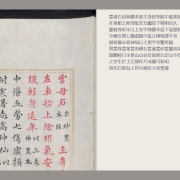
Neue Datenbank auf CrossAsia: SSAP E-Book Plattform先晓书院

Bis zum 30.11.2025 haben Sie die Gelegenheit, die Datenbank SSAP E-Book Plattform先晓书院 zu testen. Sie enthält nahezu sämtliche Medien, die der Verlag Social Sciences Academic Press seit den 1970er Jahren veröffentlicht hat: Dies sind nahezu 15.000 E-Books, 300.000 Artikel, 700.000 Bilder, über 1 Million Diagramme und Grafiken sowie mehr als 3.000 Stunden Audio- und Videomaterial. Die Inhalte werden täglich in Echtzeit automatisch aktualisiert. Rund 95% der Printausgaben liegen mittlerweile digital vor.

Enthalten sind Blaubücher, Sammelbände und großangelegte Materialsammlungen und Editionen. Die Inhalte decken das gesamte Spektrum der Geistes- und Sozialwissenschaften ab, darunter die Belt-and-Road-Initiative, Marxismus, chinesische Modernisierung, soziologische Studien, Länder- und Regionalforschung, Global Governance, die in Großbritannien aufbewahrten Dunhuang-Dokumente sowie Bibliographien. Darüber hinaus bietet die Plattform Materialien für regionale Studien, Branchenentwicklungsforschung sowie Forschung zu Schlüssel- und aktuellen Themen.


Highlighting a ‘Forgotten’ Perspective on the First World War: German POWs in Japan and the Bandō-Sammlung

Prof. Sarah Panzer von der Missouri State University war im Frühling 2025 im Rahmen des Stipendienprogramms der Stiftung Preußischer Kulturbesitz an der Staatsbibliothek in der Ostasienabteilung zu Gast und hat sich intensiv mit der Bandō-Sammlung beschäftigt. In einem Gastbeitrag berichtet sie in unserem Blog über Ihre Forschung.


Artikel zur Philippinen-Sammlung der Staatsbibliothek erschienen

In diesem Jahr waren die Philippinen erstmals Ehrengast der Frankfurter Buchmesse. Aus diesem Anlass stellt unsere Südostasien-Referentin Dr. Claudia Götze-Sam die Philippinen-Sammlung der Staatsbibliothek in dem aktuellen Themenschwerpunkt der Zeitschrift BuB – Forum Bibliothek und Information vor. Die Ausgaben werden jeweils drei Monate nach ihrem Erscheinen auf BuB online gestellt.

Götze-Sam, Claudia: Vielfalt in Sprache, Kultur und Literatur: Ein Blick in die Philippinen-Sammlung der Berliner Staatsbibliothek als Teil des Fachinformationsdienstes Asien. In: BuB. Forum Bibliothek und Information 77(2025), 10, S. 480-483.


Meet CrossAsia

Kommen Sie mit uns ins Gespräch! Unser Team wird auf folgenden Konferenzen vertreten sein:

07.-09.11.2025: „(Un)Democratic Futures: Japan and  Global Trajectories towards an (Un)Equal World“, Jahrestagung der Vereinigung für sozialwissenschaftliche Japanforschung (VSJF) an der Universität Wien.

21.-23.11.2025: XXXVI. Jahrestagung der Deutschen Vereinigung für Chinastudien „Selbstbilder – Fremdbilder“ am Asien-Afrika-Institut der Universität Hamburg


Vielen Dank für Ihr Interesse und Ihre Unterstützung. Wir freuen uns auf einen erkenntnisreichen und vielfältigen Herbst mit Ihnen!

Ihr CrossAsia Team


Unlock newspaper knowledge with CrossAsia’s AI Explorer: explore and test two new features for finding similar and possibly relevant articles across languages

The defining characteristics of newspapers are timeliness (prompt reporting on current events), periodicity (regular publication), publicity (public dissemination of information accessible to everyone) and universality (broad thematic diversity ranging from politics to culture).

But what happens when we overcome language barriers and connect newspapers and news from different countries and languages? With the CrossAsia Newspaper Explorer, we can use technology to find similar and relevant articles across languages and scripts.

We added two new AI-powered features to the CrossAsia Newspaper Explorer one is and extension to the result sets you produced by one or combined search terms from one or more sources and will “Show results by similarity”, the other starts from one of the actual titles in your result set and triggers a “Cross-language search for similar titles.” These functions use vectors embeddings*, an advanced AI technique that captures the meaning of a text beyond individual words in that text and across different languages. No worries, you do not need to understand the underlying math, just be aware of that much: each text is transformed into a matrix of numbers describing the “meanings/concepts” in a text as a vector of a certain length and angle. Considered as “similar” are texts where length and angle of these “meanings” are close. Each text is described by hundreds of these vectors in a multi-dimensional space and to actually calculate closeness and display this in a 3D space the data is reduced in complexity.

We used stsb-xlm-r-multilingual (Ollama backend) to prepare the texts for this feature, for the display of the spatial relation and some other features we use Embedding Projector.

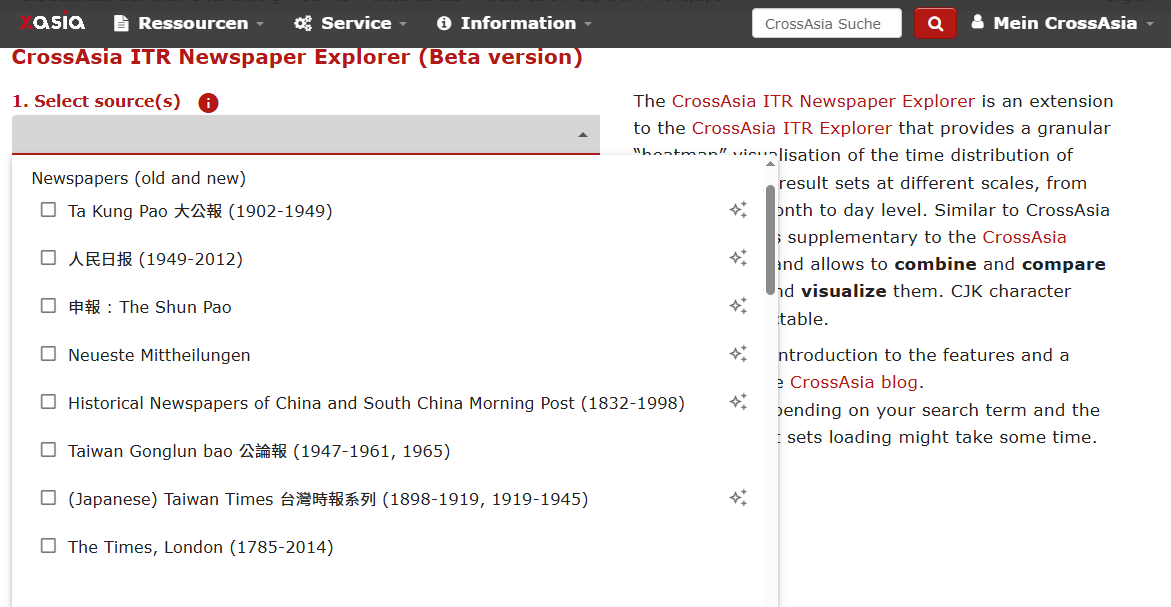
When selecting the “sources” for your search in the CrossAsia Newspaper Explorer, you will now notice a star icon  next to some data sources. This indicates that the source not only has a “word” index but in addition has been fully converted into embedding vectors and support the new features (fig.1).

*Note: Embedding vectors are numerical representations created by AI to understand and compare the meaning of text, even in different languages. For a more extensive explanation please see here: https://www.ibm.com/think/topics/vector-embedding

Fig.1: Source selection showing availability for new AI features.


Sounds too abstract? Let’s look at an example.

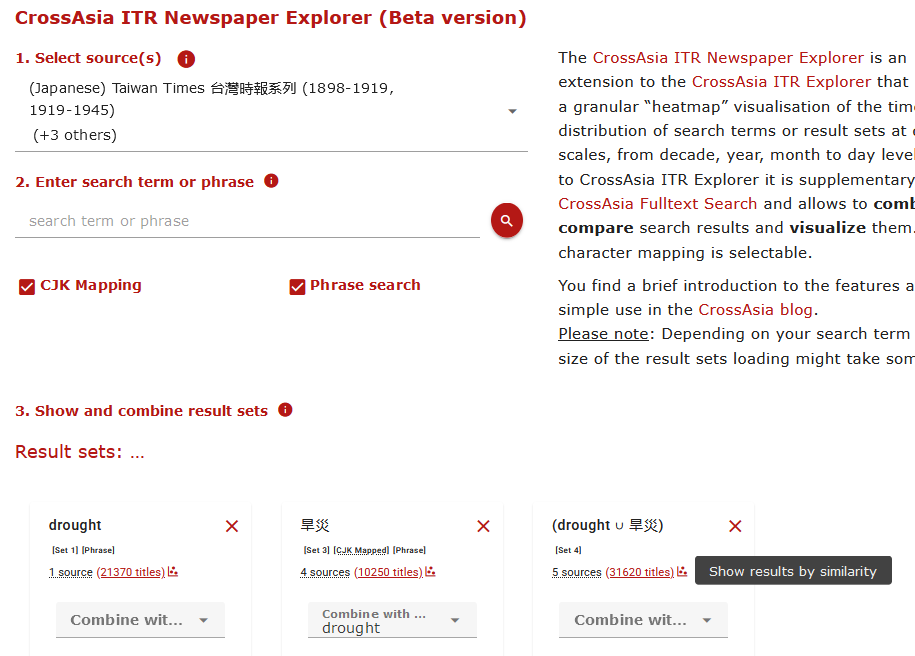
Every analysis in the ITR Explorer or Newspaper Explorer starts with producing result sets, i.e. searching for terms in sources, and – maybe – combining the result sets by OR, AND, or NOT.  Our showcase example is a combination with OR of a search for 旱災 (“drought” in Chinese) across selected Chinese and Japanese newspaper sources (with CJK Mapping enabled) plus a search for the word drought in English newspapers published in China: drought 旱災 (fig.2).

Fig.2. Production of a cross-language result set from English, Japanese and Chinese newspapers


Show result by similarity

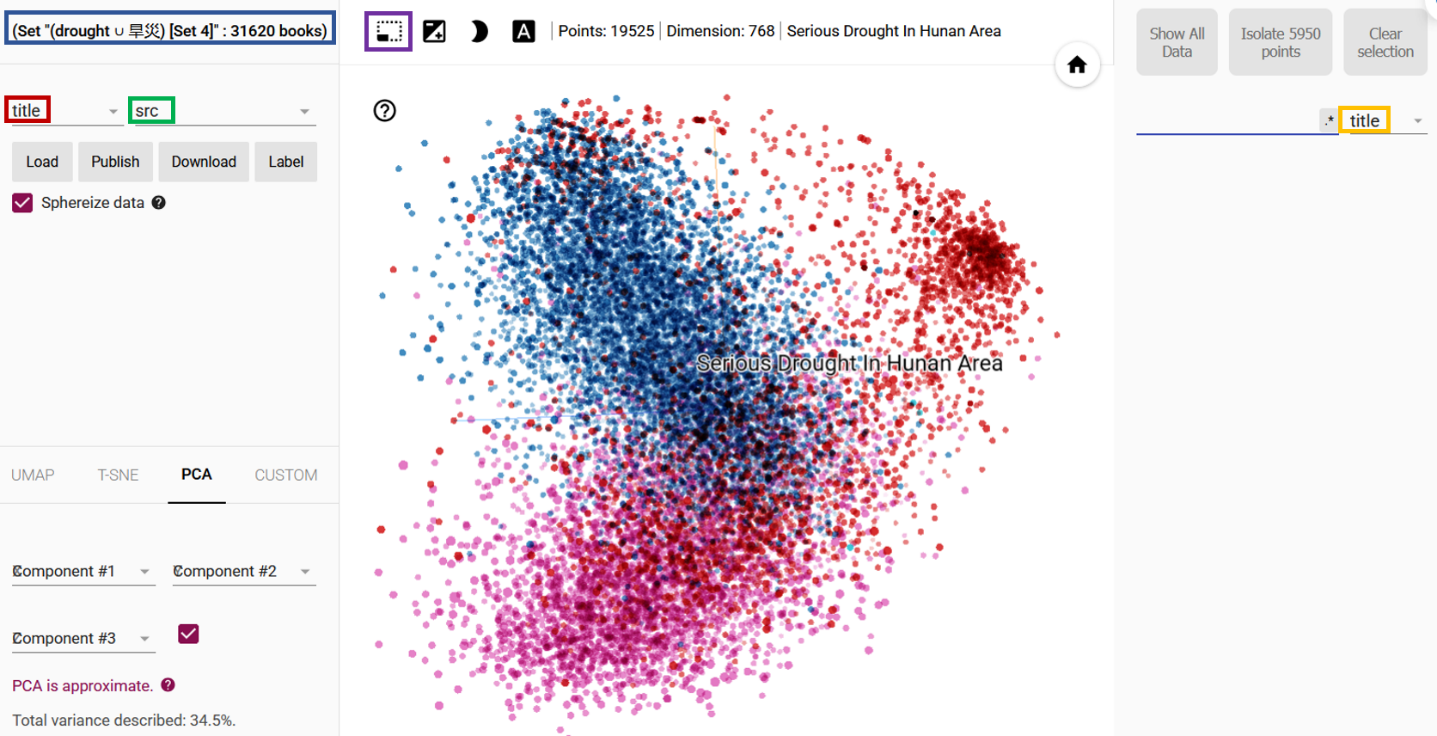
Clicking the icon in the combined result set will trigger the “Show results by similarity” function which loads all AI-based embedding vectors of the articles in the result set to the display and analysis tool Embedding Projector that will show semantically similar content across languages as a distribution with different distances and angles in a 3D space defined by the used AI model.

Fig.3: Combined result set loaded in Embedding Projector with standard settings and PCA projection


The Embedding Projector interface consists of three main sections:

  • Left Panel: Shows the name and size of the loaded result set (blue frame), controls how the data points (dots) are labeled (red frame) and colored (green frame). This is the default setting. Titles appear on hover, colors reflect different data sources (src), and PCA is used for projection. Other available option for projection are UMAP and t-SNE. The “?” next to the projection gives an introduction how to use and interpret the projection.
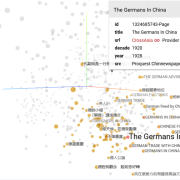
  • Center Panel: Displays the interactive embedding viewer. You can zoom, rotate, and explore the data visually. A click on a dot opens a pop-up box with some basis metadata and CrossAsia link (in red) and Provider link (in black, for users with another IP access authentication) leading directly to the article in the provider’s database.
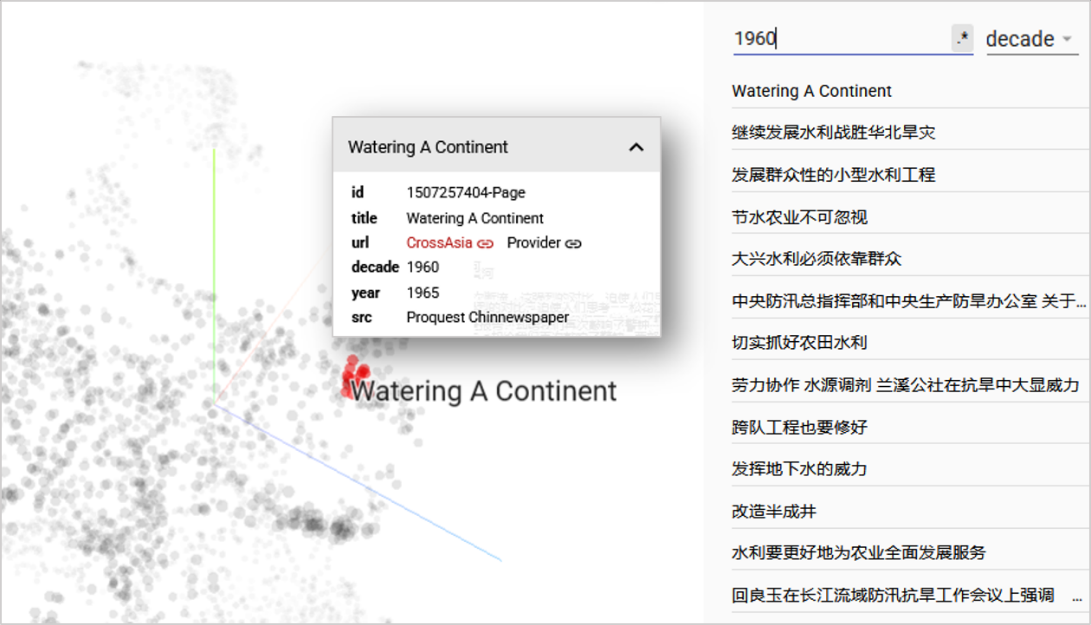
  • Right Panel: When clicking on one dot/title in the center panel, similar records are highlighted and the right panel with their distance, title, and direct link to their database. It is also possible to display only data points that match certain metadata criteria, such as containing a certain term or being published in the 1960ies (fig. 4).

Fig.4: Filtering the data points by metadata, here those of the 1960ies and showing the pop-up box for selected article.


In the next screenshot (fig.5), the same result set uses UMAP to project the records.

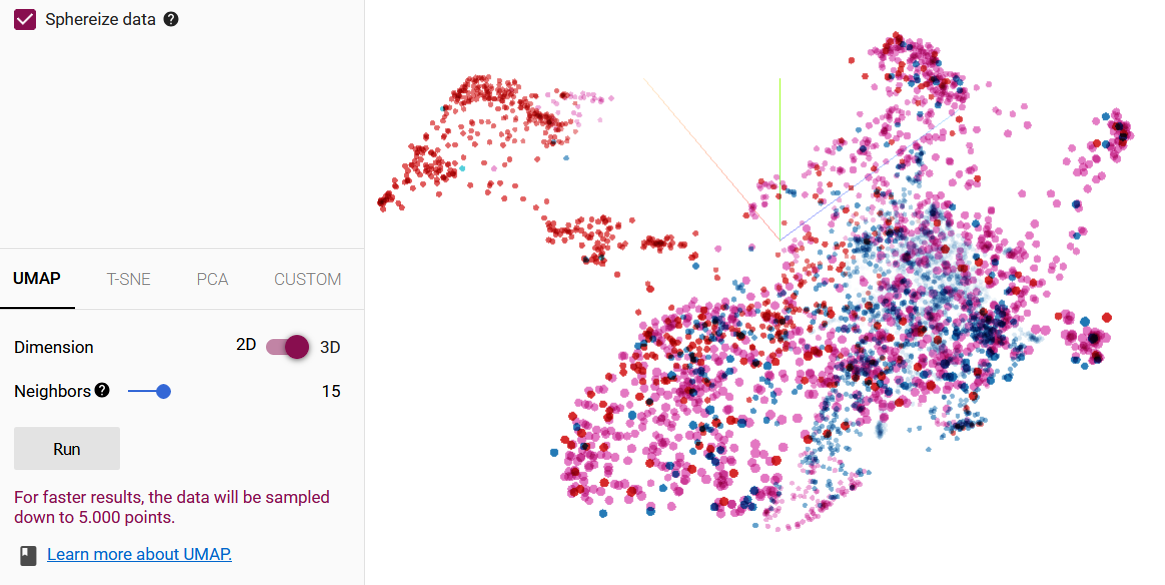
Fig.5: UMAP projection of result set “drought ∪ 旱災”


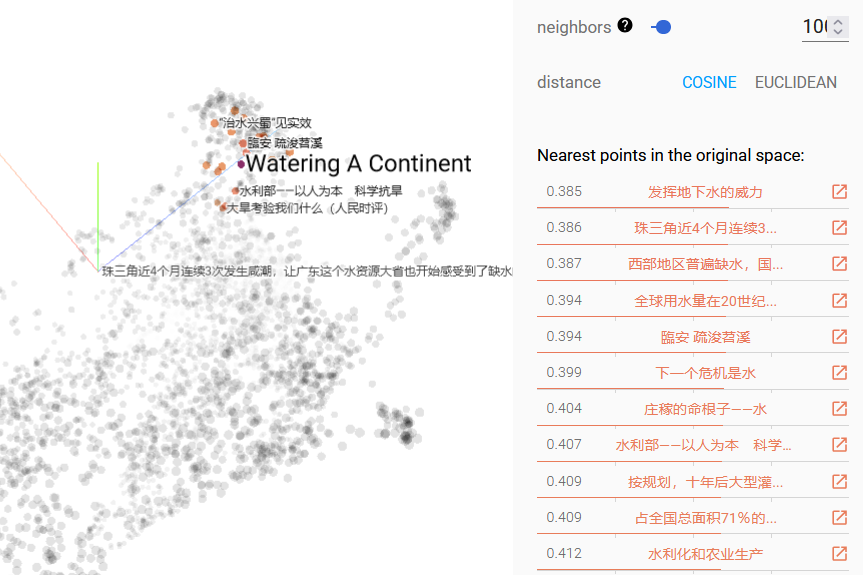
Let’s explore the cluster of records in the upper middle where blue (English), pink and red (Chinese from RMRB and Dagong bao) titles mix by drawing a box (see fig. 3, lilac framed icon) around that cluster. The selection suggests that the articles are “similar” because “water management/水利” play a central role in them.

Fig.6: Exploring one cluster of records in the UMAP projection


“Cross-language search for similar titles”

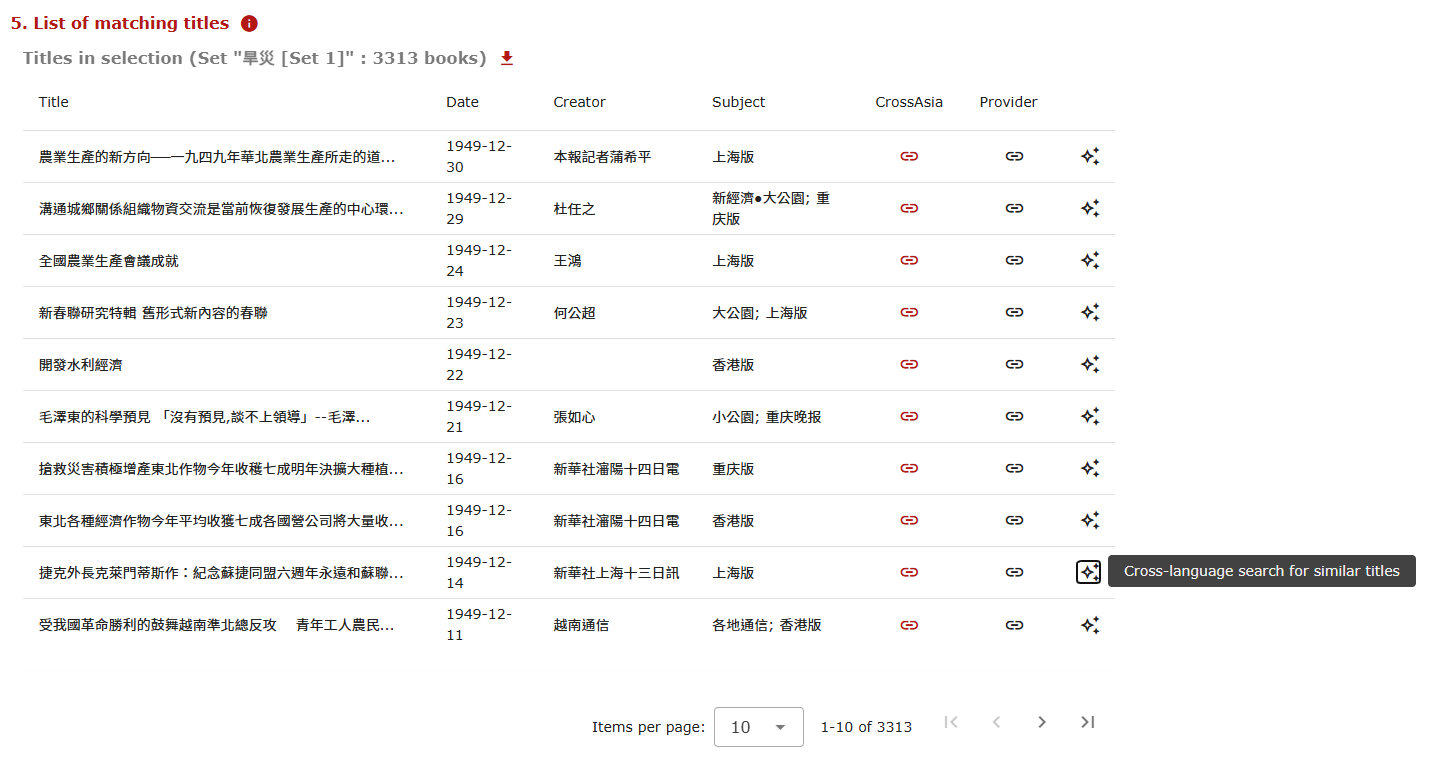
The second new feature of the CrossAsia ITR Newspaper Explorer is an addition to the fifth section in the ITR Explorer interface: “List of matching titles”. This function has the same features as the one described above, but displays not a pre-defined set of titles, but starts from one specific article within the result set to then search for similar titles across all data sources in which this AI feature is enabled. A click on the star icon next to one of the titles will trigger the search and display (fig. 7).

Fig.7: Starting an AI exploration from the list of matching titles


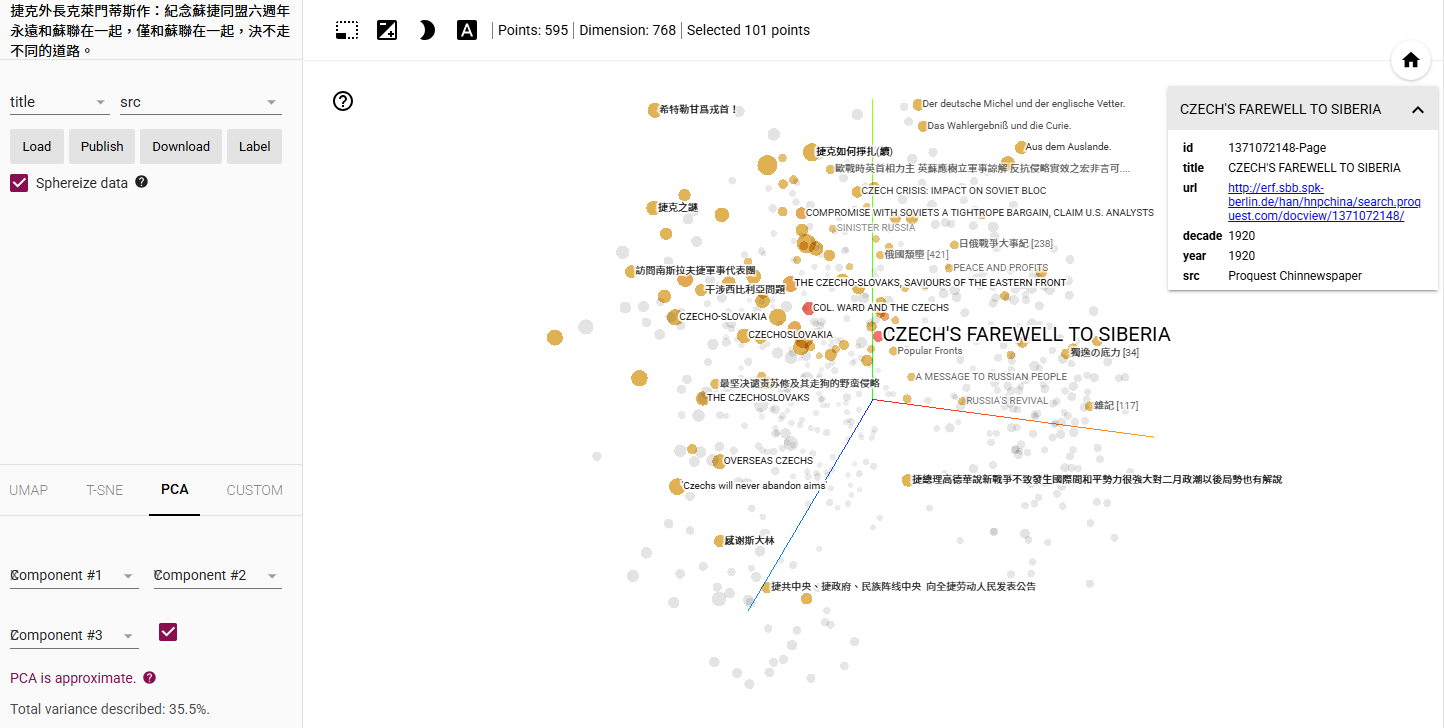
Starting from the Chinese article “捷克外長克萊門蒂斯作:紀念蘇捷同盟六週年永遠和蘇聯” (Czech Foreign Minister Clementis: Commemorating the Sixth Anniversary of the Soviet-Czech Alliance, Forever with the Soviet Union) the AI search will find “similar titles” also in other languages than Chinese such as the English newspaper article “CZECH’S FAREWELL TO SIBERIA” (fig. 8).

Fig.8: Display of result of a Chinese article will also show English articles that are considered similar in “meaning”

No tool makes sense without users!

Please share your experiences when using the new ITR Newspaper feature with us and the community. Have you found interesting and un-expected but useful results using this feature? Have you advised for other users how to best proceed making best use it? Please share as comments to this blog. Thank you!

The new features are – as are all CrossAsia Lab tools – open to all users and not confined to those being able to access the licensed databases. If you find flaws or errors or have suggestions for improvement, do not hesitate to contact us via the x-asia address or use the comment function in the CrossAsia Forum.

Highlighting a ‘Forgotten’ Perspective on the First World War: German POWs in Japan and the Bandō-Sammlung

Gastbeitrag von Prof. Sarah Panzer

The staggering quantity of literature on the First World War can give rise to the mistaken impression that scholars have already said all that there is to say on the topic, especially in the wake of the many fine publications which emerged out of the centenary commemorations of the conflict. Growing recent interest in the conflict’s global dimensions, as well as the diverse experiences of captivity and internment faced by military prisoners and civilians alike, however, have illuminated new directions for scholars to pursue. Even within this literature, the East Asian front of the First World War has been largely relegated to the status of a historical footnote, a function both of its geographic distance and its brevity, at least militarily.

On 23 August 1914, Japan declared war on Imperial Germany, using its alliance with Great Britain as a convenient pretext in claiming Germany’s colonial possessions in Asia for its own. By mid-October the Japanese Navy successfully occupied German Micronesia and on 7 November the German garrison at Tsingtao (Qingdao) surrendered to the 18th Infantry Division of the Japanese Imperial Army, supported by a symbolic contingent of British troops. The nearly 4,700 German and Austrian servicemen captured at Tsingtao were subsequently transported to the Japanese mainland, where they were housed in a series of temporary camps throughout central Japan. Once it became clear that the war would not be ending as quickly as initially predicted, these camps were replaced by larger, more comfortable facilities intended to mitigate the prisoners’ boredom and loneliness.

Repatriation of the POWs only began in 1919, with the final prisoners returning to Germany (excepting those who chose to remain in Asia) in 1920. Over the course of their five-year captivity, these men produced a significant archival record of their lives in Japan, including camp newspapers, printed objects such as concert programs and postcards, personal diaries and memoirs, and dozens of photographs. The Bandō-Sammlung, held since late 2021 in the Ostasienabteilung of the SBB-PK, sheds invaluable light on a dimension of that conflict which has been so far largely overlooked by researchers outside of Japan.

The Best Camp in the World

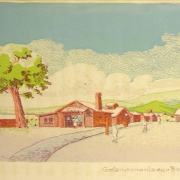
Camp Bandō was one of the ‘second generation’ camps opened during the war; it opened in early April 1917 and was officially closed three years later, on 1 April 1920. Located on the island of Shikoku and built to accommodate the prisoners previously held in the camps in Matsuyama, Marugame, and Tokushima, Bandō quickly acquired a reputation as a model camp because of its many well-resourced facilities and opportunities for cultural and social diversion. The camp included living quarters, administrative buildings, kitchens, and baths, as well as two small lakes (one of which was used by the prisoners for boating) and a small ‘commercial district’ with some eighty shops, specializing in everything from bookbinding and photography to furniture construction and musical instrument repair. (Fig. 1) Just outside the camp the prisoners also had access to a large sports complex, which boasted a soccer field, a Turnhalle, and eight tennis courts.
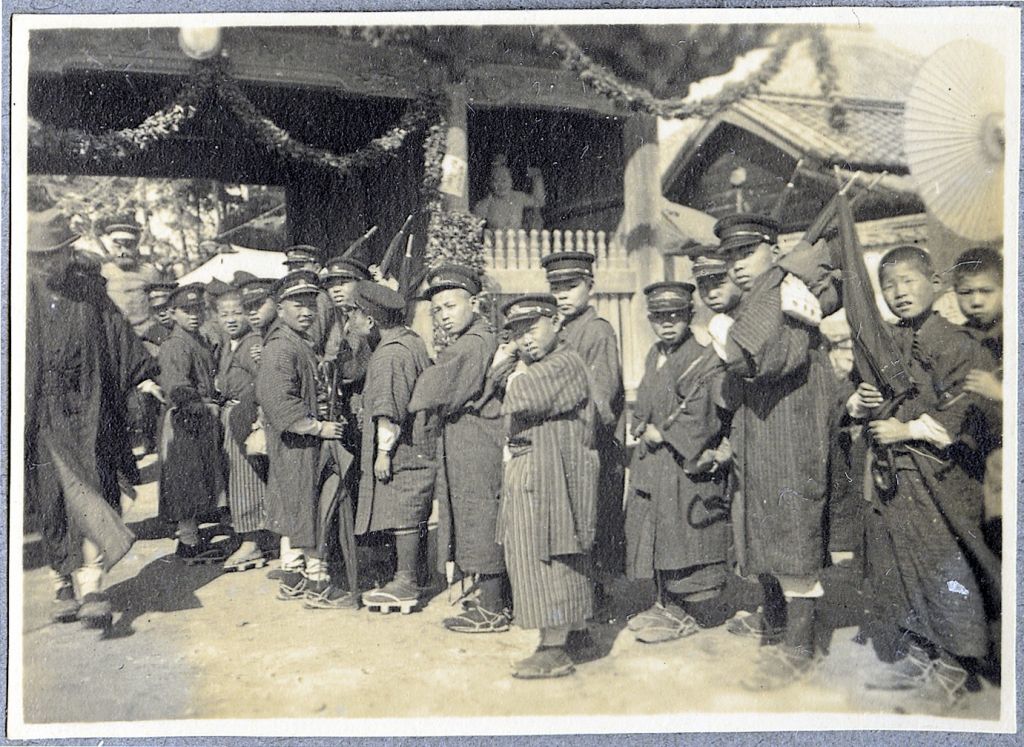
Fig. 2: A group of students waits in line to enter the exhibition of “visual arts and handicrafts” organized by the residents of Bandō POW camp. The exhibition was hosted by the nearby Ryōzenji temple, hence the statue in the center of the image. A no less imposing bearded German soldier is visible on the lefthand side of the photo. SBB-PK. Bandō-Sammlung H 57-07.

Fig. 2: A group of students waits in line to enter the exhibition of “visual arts and handicrafts” organized by the residents of Bandō POW camp. The exhibition was hosted by the nearby Ryōzenji temple, hence the statue in the center of the image. A no less imposing bearded German soldier is visible on the lefthand side of the photo. SBB-PK. Bandō-Sammlung H 57-07.

Even at the time, prisoners referred to Bandō as the “best camp in the world,” and both the camp and its commander—Lieutenant Colonel Toyohisa Matsue—have become synonymous in contemporary popular memory in Japan with a humane and tolerant approach to internment, which facilitated not only a (relatively) pleasant experience for the prisoners themselves, but also a mutually beneficial circuit of cultural and intellectual exchange between the German prisoners and their Japanese neighbors. One striking example was the exhibition of “visual arts and handicrafts” organized by Bandō’s residents in March 1918. Visitors could peruse the works on display—which included everything from oil paintings to technical models to taxidermied local birds—at their leisure or receive a guided tour by a prisoner-translator, visit one of the concession stands and sample ‘authentic’ German baked goods, try their luck at one of the carnival games operated by the prisoners outside, or simply relax and listen to music performed by one of the camp’s multiple ensembles. (Fig. 2) With a reported total attendance of just over 50,000 visitors over twelve days, Bandō’s camp newspaper Die Baracke concluded that the exhibition had been a triumph of cultural diplomacy:

“Thousands of inhabitants of the country which holds us captive have admired the works of German POWs with their own eyes, and hundreds of thousands have heard about them through word of mouth and newspapers. To those who had been repeatedly exposed to the image of the German Barbarian since the beginning of the war, we were able to show them with our exhibit ‘Hie gut Deutschland alleweg!’—Thus, even with our modest resources, we were able to render a service to the Fatherland.”

(Die Baracke I, no. 25 [17 March 1918], 42. SBB-PK. Bandō-Sammlung A 2-1)

This quotation is a useful reminder that, their official status as POWs notwithstanding, the residents of Bandō saw themselves as participants in the ongoing global war. The activities and groups with which they occupied themselves were never simply about staying busy; they were also meant to project an image of German resilience, strength, and cultural superiority meant to function as ‘counter-programming’ to British and French propaganda.

Fighting Vicariously

The POWs held in Japan were avid consumers of news about the war’s progress, militarily and politically. Far from being isolated from the events back in Europe, prisoners were kept up-to-date through regular telegram transmissions—in the case of Bandō, these transmissions were recorded daily and made available to the camp’s residents through a subscription-based bulletin—from New York, London, Paris, and Moscow. German-language media was less consistently available, but newspapers, books and other printed materials shipped from Europe provided prisoners with an invaluable sense of connection to the German war effort. This ongoing interest in the war was, in one sense, eminently practical—although rumors of prisoner swaps or early parole persisted, most recognized that they were ‘stuck’ in Japan until the war ended—but it also speaks to the powerful sense of national unity and purpose which emerged in German-speaking Europe during the First World War.

Die Baracke featured monthly articles summarizing the major battles, personalities, and strategic developments on the war’s various fronts, as well as significant political events like the October Revolution in Russia. Likewise, President Woodrow Wilson’s public comments and speeches denouncing German autocracy and claiming that the US was fighting to secure a just and lasting peace for the peoples of the world, was met with scathing commentary in the pages of Die Baracke, with one article sarcastically responding, point-by-point, to Wilson’s rhetoric:

“‘America refuses to impose its will by exploiting the weakness and internal unrest of other countries.’
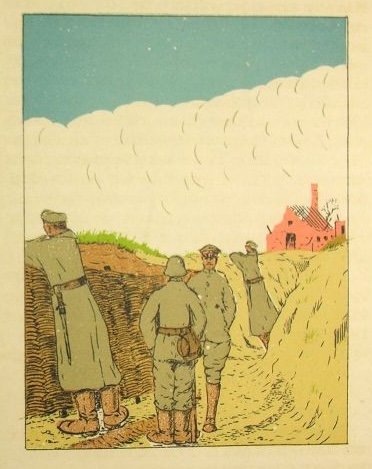
Fig. 3: Illustration of German trenches on the Western Front. The almost bucolic scene betrays the illustrator’s lack of familiarity with the realities of trench warfare. Drei Märchen von E. Behr. SBB-PK. Bandō-Sammlung B 06.

But you should not have said that Herr Professor… Mr. President! Or has your noble life’s work, the study and destruction of brutal German militarism, so completely occupied you that you have never heard of the Spanish-American War – it was in 1898? Your high-minded country has its own delicate American militarism, which was quite involved at the time ‘exploiting the weakness of other countries,’ to thank for the not quite so independent, rich island of Cuba and the likewise not entirely poor, not entirely independent Philippines.”

(Die Baracke I, no. 22 [24 February 1918], 13-14. SBB-PK. Bandō-Sammlung A 2-2)

On one level, these articles reflect the appetite for news about the war, in all its various dimensions, among the POWs in Japan; other articles published in Die Baracke, as well as public lectures in the camp, commented on modern military technology and tactics, specific battles, and the mobilization of the home front. Indeed, one of the more interesting artifacts of the Bandō-Sammlung is the lavishly illustrated book of modern German fairy tales published by the camp printing press in 1918; the first of the three stories takes place largely in the trenches of the Western Front, already an icon of contemporary cultural memory which neither the story’s author nor its illustrator had ever actually seen for themselves. (Fig. 3)

More meaningfully, however, they also demonstrate the intense emotional investment of the POWs with the German state, the German war effort, and with German war nationalism more generally. Kaiser Wilhelm II’s birthday was celebrated in the camp with lavish festivities, and tributes to the Prussian royal dynasty, Bismarck, and Field Marshal Paul von Hindenburg became a regular feature in Die Baracke. (Fig. 4)
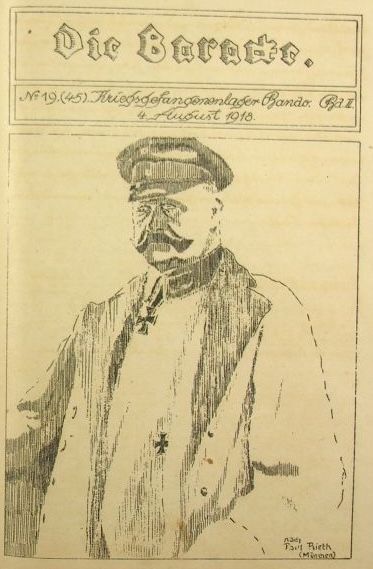
Fig. 4: A special cover of Die Baracke celebrating the hero of Tannenberg Field Marshal Paul von Hindenburg. By 1918 a veritable cult of personality had coalesced around Hindenburg in Germany, and apparently in Bandō as well. Die Baracke II, no. 19 (4 August 1918), 489. SBB-PK. Bandō-Sammlung A 2-2.

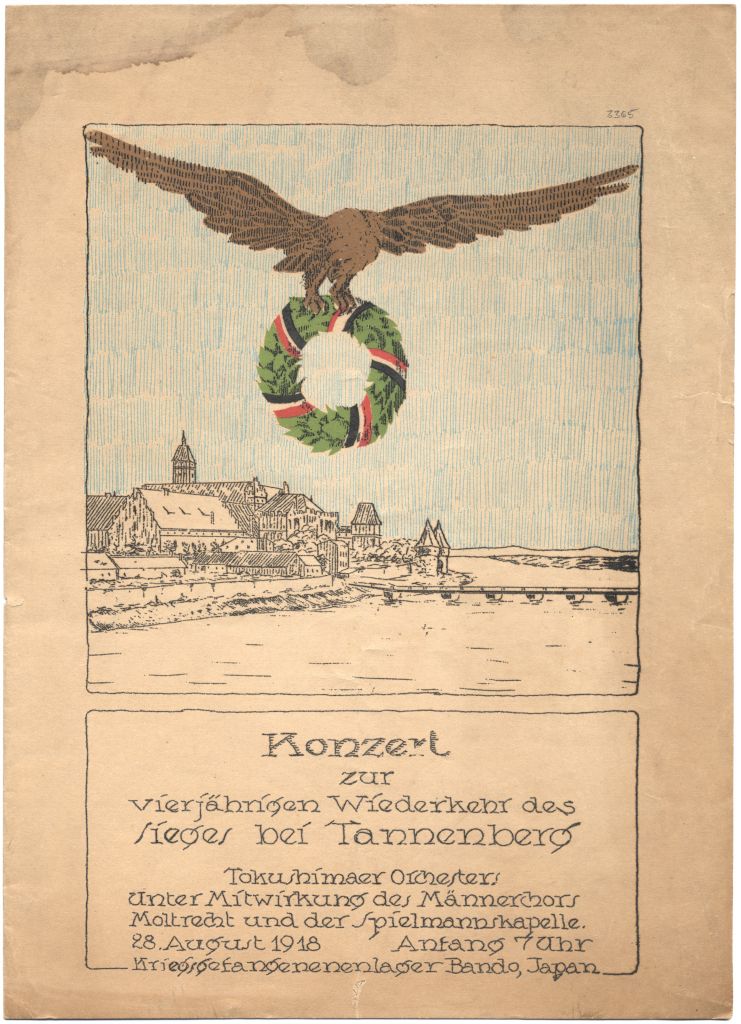
Notable battles from earlier in the war, such as the Battle of Tannenberg, were commemorated with special concerts. (Fig. 5) Nor were the residents of Bandō content to be mere observers, their circumstances notwithstanding; they (re)mobilized themselves as active participants in the war effort through fundraisers on behalf of their fellow German POWs in Siberia. It is not entirely surprising that the war would have been on the minds of these men; what is noteworthy, however, are the patterns revealed by their consumption of news and propaganda as an integral element of their performance as good and loyal Germans.
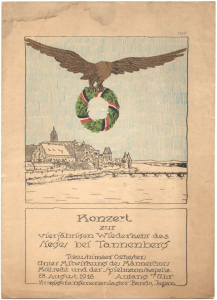
Fig. 5: Program for a concert by the Tokushimaer Orchestra in commemoration of the fifth anniversary of the Battle of Tannenberg. SBB-PK. Bandō-Sammlung E 3-17.

The German and Austrian POWs held in Japan during the First World War were determined to not be forgotten by their political leaders and fellow countrymen. Accordingly, they documented their lives in Japan, their thoughts on the war, and their feelings towards German culture and national identity in a variety of sources. This research was conducted as part of a broader project examining the POW camps in Japan as sites of cultural engagement and exchange, but also transformation as the prisoners were forced to reconcile their previous relationship to the German nation with the reality of defeat and decolonization.


Frau Prof. Sarah Panzer, Missouri State University, war im Rahmen des Stipendienprogramms der Stiftung Preußischer Kulturbesitz im Jahr 2025 als Stipendiatin an der Staatsbibliothek zu Berlin. Forschungsprojekt: „German-Austrian Prisoners of War (POWs) in Japan during the First World War“

Vortrag im Rahmen von CrossAsia Talks am 04.09.2025

Dieser Beitrag erschien zuerst im SBB-Blog.

 

Neuer Testzugang: 15.000 eBooks von SSAP

Bis zum 30.11.2025 haben Sie die Gelegenheit, die SSAP E-Book Plattform先晓书院 zu testen. Sie enthält nahezu sämtliche Medien, die der Verlag Social Sciences Academic Press seit den 1970er Jahren veröffentlicht hat: Dies sind nahezu 15.000 E-Books, 300.000 Artikel, 700.000 Bilder, über 1 Million Diagramme und Grafiken sowie mehr als 3.000 Stunden Audio- und Videomaterial. Die Inhalte werden täglich in Echtzeit automatisch aktualisiert. Rund 95% der Printausgaben liegen mittlerweile digital vor.

Enthalten sind Blaubücher, Sammelbände und großangelegte Materialsammlungen und Editionen. Die Inhalte decken das gesamte Spektrum der Geistes- und Sozialwissenschaften ab, darunter die Belt-and-Road-Initiative, Marxismus, chinesische Modernisierung, soziologische Studien, Länder- und Regionalforschung, Global Governance, die in Großbritannien aufbewahrten Dunhuang-Dokumente sowie Bibliographien. Darüber hinaus bietet die Plattform Materialien für regionale Studien, Branchenentwicklungsforschung sowie Forschung zu Schlüssel- und aktuellen Themen.

Viel Spaß beim Testen!

Ihr Feedback gern an x-asia.

Ihr CrossAsia Team