Aktuelles

Neuer Test: Contemporary Chinese Newspaper Full-Text Database mit 737 Zeitungen

Bis zum 31.12.2025 haben Sie Gelegenheit, die Contemporary Chinese Newspaper Full-Text Database 当代中文数字报纸数据库 mit einem großen Fundus an 737 ! regionalen und überregionalen Tages-, Abend- und Wochenzeitungen zu testen. Der Testzugang dient der Erprobung der Funktionalität, daher werden lediglich rezente Jahrgänge angeboten. Mit der Lizenzierung der Datenbank würden auch die jeweiligen Archive der Zeitungen zur Verfügung stehen.

Sie können nach Zeitungen stöbern oder aber gezielt nach Artikeln, Seiten und Bildern (mithilfe der Bildunterschriften) suchen.

Wir wünschen viel Spaß beim Ausprobieren und freuen uns über Ihr Feedback an x-asia.

Ihr CrossAsia-Team

CrossAsia Classroom: Online-Seminare im Wintersemester 2025/26

Liebe Nutzer:innen,

auch im Wintersemester 2025/26 lädt das CrossAsia-Team Sie wieder zu zahlreichen Online-Schulungen zu unseren Angeboten ein. Neben Schulungen zu den Besonderheiten der einzelnen Regionen (Chinesischsprachige Regionen, Japan, Korea, Südostasien und Zentralasien) wird es auch wieder Schulungen zu einzelnen Datenbanken geben. Zudem bieten wir erneut eine Schulung zum CrossAsia Repository an. Außerdem haben wir zwei Spezialschulungen ins Programm aufgenommen: „Secondary sources for Chinese Studies: academic eBooks, theses, journals“ und „CrossAsia ITR services introduction“.

Die Schulungen beginnen am 29. Oktober mit einer Allgemeinen Einführung zu CrossAsia. Das vollständige Programm des CrossAsia Classrooms finden Sie hier sowie unter der Rubrik „Workshops und mehr“ im Veranstaltungskalender der Staatsbibliothek zu Berlin.

Auf der CrossAsia Classroom-Seite finden Sie außerdem aktuelles Infomaterial zu den einzelnen Regionen und Links zu unseren CrossAsia Tutorials.

Fall Sie als Institution ein auf Sie und ihr Publikum zugeschnittenes Web-Seminare kostenfrei buchen möchten, können Sie sich gerne über xasia@sbb.spk-berlin.de mit uns in Verbindung setzen oder direkt unsere regionalen Referent:innen dahingehend kontaktieren.

***

Dear users,

The CrossAsia team would like to invite you to numerous online training courses on our services in the winter semester 2025/26. In addition to training courses on the specifics of individual regions (Chinese-speaking regions, Japan, Korea, Southeast Asia and Central Asia, there will also be training courses on individual databases. We are also offering another training course on the CrossAsia Repository. In addition, we have added two special training courses to the programme: ‘Secondary sources for Chinese Studies: academic eBooks, theses, journals’ and ‘CrossAsia ITR services introduction’.

The training courses begin on October 29 with a general introduction to CrossAsia. The complete programme of the CrossAsia Classroom can be found here as well as under the heading ‘Workshops und mehr’ in the event calendar of the Berlin State Library.

On the CrossAsia Classroom page, you will also find up-to-date information material on the individual regions and links to our CrossAsia tutorials.

If you are an institution and would like to book a free web seminar tailored to you and your audience, please feel free to contact us at xasia@sbb.spk-berlin.de or contact our regional subject specialists directly.


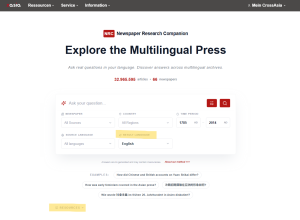
Unlock newspaper knowledge with CrossAsia’s AI Explorer: explore and test two new features for finding similar and possibly relevant articles across languages

The defining characteristics of newspapers are timeliness (prompt reporting on current events), periodicity (regular publication), publicity (public dissemination of information accessible to everyone) and universality (broad thematic diversity ranging from politics to culture).

But what happens when we overcome language barriers and connect newspapers and news from different countries and languages? With the CrossAsia Newspaper Explorer, we can use technology to find similar and relevant articles across languages and scripts.

We added two new AI-powered features to the CrossAsia Newspaper Explorer one is and extension to the result sets you produced by one or combined search terms from one or more sources and will “Show results by similarity”, the other starts from one of the actual titles in your result set and triggers a “Cross-language search for similar titles.” These functions use vectors embeddings*, an advanced AI technique that captures the meaning of a text beyond individual words in that text and across different languages. No worries, you do not need to understand the underlying math, just be aware of that much: each text is transformed into a matrix of numbers describing the “meanings/concepts” in a text as a vector of a certain length and angle. Considered as “similar” are texts where length and angle of these “meanings” are close. Each text is described by hundreds of these vectors in a multi-dimensional space and to actually calculate closeness and display this in a 3D space the data is reduced in complexity.

We used stsb-xlm-r-multilingual (Ollama backend) to prepare the texts for this feature, for the display of the spatial relation and some other features we use Embedding Projector.

When selecting the “sources” for your search in the CrossAsia Newspaper Explorer, you will now notice a star icon  next to some data sources. This indicates that the source not only has a “word” index but in addition has been fully converted into embedding vectors and support the new features (fig.1).

*Note: Embedding vectors are numerical representations created by AI to understand and compare the meaning of text, even in different languages. For a more extensive explanation please see here: https://www.ibm.com/think/topics/vector-embedding

Fig.1: Source selection showing availability for new AI features.


Sounds too abstract? Let’s look at an example.

Every analysis in the ITR Explorer or Newspaper Explorer starts with producing result sets, i.e. searching for terms in sources, and – maybe – combining the result sets by OR, AND, or NOT.  Our showcase example is a combination with OR of a search for 旱災 (“drought” in Chinese) across selected Chinese and Japanese newspaper sources (with CJK Mapping enabled) plus a search for the word drought in English newspapers published in China: drought 旱災 (fig.2).

Fig.2. Production of a cross-language result set from English, Japanese and Chinese newspapers


Show result by similarity

Clicking the icon in the combined result set will trigger the “Show results by similarity” function which loads all AI-based embedding vectors of the articles in the result set to the display and analysis tool Embedding Projector that will show semantically similar content across languages as a distribution with different distances and angles in a 3D space defined by the used AI model.

Fig.3: Combined result set loaded in Embedding Projector with standard settings and PCA projection


The Embedding Projector interface consists of three main sections:

  • Left Panel: Shows the name and size of the loaded result set (blue frame), controls how the data points (dots) are labeled (red frame) and colored (green frame). This is the default setting. Titles appear on hover, colors reflect different data sources (src), and PCA is used for projection. Other available option for projection are UMAP and t-SNE. The “?” next to the projection gives an introduction how to use and interpret the projection.
  • Center Panel: Displays the interactive embedding viewer. You can zoom, rotate, and explore the data visually. A click on a dot opens a pop-up box with some basis metadata and CrossAsia link (in red) and Provider link (in black, for users with another IP access authentication) leading directly to the article in the provider’s database.
  • Right Panel: When clicking on one dot/title in the center panel, similar records are highlighted and the right panel with their distance, title, and direct link to their database. It is also possible to display only data points that match certain metadata criteria, such as containing a certain term or being published in the 1960ies (fig. 4).

Fig.4: Filtering the data points by metadata, here those of the 1960ies and showing the pop-up box for selected article.


In the next screenshot (fig.5), the same result set uses UMAP to project the records.

Fig.5: UMAP projection of result set “drought ∪ 旱災”


Let’s explore the cluster of records in the upper middle where blue (English), pink and red (Chinese from RMRB and Dagong bao) titles mix by drawing a box (see fig. 3, lilac framed icon) around that cluster. The selection suggests that the articles are “similar” because “water management/水利” play a central role in them.

Fig.6: Exploring one cluster of records in the UMAP projection


“Cross-language search for similar titles”

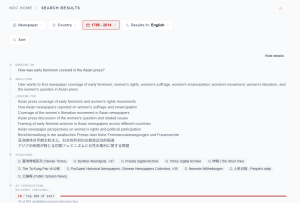
The second new feature of the CrossAsia ITR Newspaper Explorer is an addition to the fifth section in the ITR Explorer interface: “List of matching titles”. This function has the same features as the one described above, but displays not a pre-defined set of titles, but starts from one specific article within the result set to then search for similar titles across all data sources in which this AI feature is enabled. A click on the star icon next to one of the titles will trigger the search and display (fig. 7).

Fig.7: Starting an AI exploration from the list of matching titles


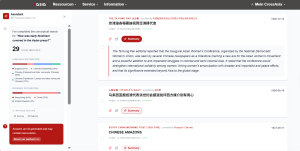
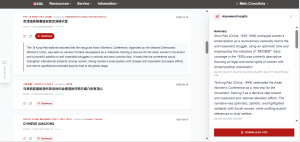
Starting from the Chinese article “捷克外長克萊門蒂斯作:紀念蘇捷同盟六週年永遠和蘇聯” (Czech Foreign Minister Clementis: Commemorating the Sixth Anniversary of the Soviet-Czech Alliance, Forever with the Soviet Union) the AI search will find “similar titles” also in other languages than Chinese such as the English newspaper article “CZECH’S FAREWELL TO SIBERIA” (fig. 8).

Fig.8: Display of result of a Chinese article will also show English articles that are considered similar in “meaning”

No tool makes sense without users!

Please share your experiences when using the new ITR Newspaper feature with us and the community. Have you found interesting and un-expected but useful results using this feature? Have you advised for other users how to best proceed making best use it? Please share as comments to this blog. Thank you!

The new features are – as are all CrossAsia Lab tools – open to all users and not confined to those being able to access the licensed databases. If you find flaws or errors or have suggestions for improvement, do not hesitate to contact us via the x-asia address or use the comment function in the CrossAsia Forum.

Zwischen Identitätsfindung und Spurensuche: 100 Jahre Textgeschichte der Verfassungen der Mongolei

Sehr geehrte Damen und Herren, liebe CrossAsia Nutzer:innen,

wir laden Sie herzlich zu unserer Veranstaltung ein, die sich der fassettenreichen Verfassungsgeschichte der Mongolei widmet. Anlässlich des 100-jährigen Jubiläums der mongolischen Verfassungstradition zum Ende 2024 beleuchten wir die bewegte Geschichte zwischen dem Ringen um Identität und der Suche nach historischen Spuren.

Datum: 1. Oktober 2025
Uhrzeit: 18:00 Uhr
Ort: Staatsbibliothek zu Berlin – Preußischer Kulturbesitz, Wilhelm von Humboldt-Saal, Unter den Linden 8, 10117 Berlin

Programm

18:00 Uhr         Begrüßung
18:10 Uhr          Dr. Oliver Corff: „Zwischen Identitätsfindung und Spurensuche: 100 Jahre Textgeschichte der Verfassungen der Mongolei“
19:00 Uhr         Diskussionsrunde mit Botschafter Birvaa Mandakhbileg, Herrn Dietrich Nelle und N.N.
19:30 Uhr          Empfang und Ausstellungsbesichtigung

Ausstellung

Im Rahmen der Veranstaltung präsentieren wir eine Ausstellung mongolischer Verfassungsdokumente in vier thematischen Vitrinen. Die Ausstellung wird einmalig nur an diesem Abend gezeigt.

  • Pracht- und Dekorausgaben – Zeugnisse symbolischer Befrachtung
  • Sozialistische Ausgaben (bis 1990) – Dokumente der Volksrepublik
  • Demokratische Ausgaben (ab 1990) – Zeugnisse des Wandels
  • Übersetzungen – Die mongolische Verfassung in der Welt

Wir freuen uns auf Ihr Kommen und einen spannenden Abend zur mongolischen Verfassungsgeschichte!

Um Anmeldung wird gebeten unter: https://pretix.eu/StaatsbibliothekZuBerlin/mongolei1-10-25/.

Während der Veranstaltung werden Bildaufnahmen für die Öffentlichkeitsarbeit der Staatsbibliothek zu Berlin angefertigt. Mit Ihrer Anmeldung stimmen Sie der Veröffentlichung zu nichtkommerziellen Zwecken zu.

CrossAsia Talks: Marlene Erschbamer 25.09.2025

(See English below)

Wir freuen uns, Sie zum ersten tibetologischen CrossAsia Talk des Jahres einzuladen: Am 25. September 2025, ab 18 Uhr (Berliner Zeit), wird Frau Dr. Marlene Erschbamer in einem Online-Vortrag über „Reading Outside the Lines – Mutterschaft und Mutterrollen in der Barawa Kagyü Tradition des tibetischen Buddhismus“ referieren.

Mutterschaft ist eine komplexe und höchst ambivalente Rolle für Frauen. Noch komplexer wird es, wenn Mutterrollen durch eine religiöse Brille betrachtet werden. Dies gilt auch für die Darstellung von Müttern im tibetischen Buddhismus. Um sich ein Bild von Mutterschaft im Laufe der Jahrhunderte zu machen, ist es hilfreich, zwischen den Zeilen, aber auch außerhalb der Zeilen tibetischer Texte zu lesen.
Aus tibetisch-buddhistischer Sicht wird von Frauen erwartet, liebevolle und fürsorgliche Mütter zu sein, idealerweise für alle fühlenden Wesen. Gleichzeitig bedeutet Mutterschaft ein Hindernis auf dem eigenen spirituellen Weg. Mutterschaft spielt sich zwischen Liebe und Mitgefühl ab, ist aber auch mit Herausforderungen, Enttäuschungen und Schwierigkeiten verbunden.
Dieser Vortrag gibt einen Einblick in die verschiedenen Darstellungen von Müttern innerhalb buddhistischer Traditionen, wobei der Schwerpunkt auf der Barawa-Kagyü-Tradition liegt. Es werden Themen angesprochen wie z.B. idealisierte Darstellungen von Empfängnis, Schwangerschaft und Geburt eines buddhistischen Meisters, Geburtshindernisse und Herausforderungen der Mutterschaft sowie die Mutterschaft buddhistischer Nonnen. Außerdem wird untersucht, ob männliche und weibliche Autoren Mütter in buddhistischen Texten unterschiedlich beschreiben und welche Aspekte der Mutterschaft sie jeweils thematisieren. Präsentiert werden Auszüge aus tibetischen, sikkimesischen und bhutanesischen Quellen der Barawa-Kagyü-Tradition, die sich zum Teil im Besitz der Staatsbibliothek zu Berlin befinden.

Die Vortragssprache ist Englisch. Bei Fragen kontaktieren Sie uns unter: ostasienabt@sbb.spk-berlin.de.

Der Vortrag wird darüber hinaus via Webex gestreamt und aufgezeichnet*. Sie können am Vortrag über Ihren Browser ohne Installation einer Software teilnehmen. Klicken Sie dazu unten auf „Zum Vortrag“, folgen dem Link „Über Browser teilnehmen“ und geben Ihren Namen ein.

Alle bislang angekündigten Vorträge finden Sie hier. Die weiteren Termine kündigen wir in unserem Blog und auf unserem X-Account, Mastodon und BlueSky an.

We are delighted to invite you to the first Tibetological CrosAsia Talk of this year: On September 25, 2025, at 6 pm (Berlin time), Dr. Marlene Erschbamer will present an online lecture on „Reading Outside the Lines – Motherhood and the Roles of Mothers within the Barawa Kagyu Tradition of Tibetan Buddhism„.

Motherhood is a complex and highly ambivalent role for women. It becomes even more complicated when the roles of mothers are examined through a religious lens. This applies also to the image of motherhood in Tibetan Buddhism. To get an idea of motherhood through the centuries, it is helpful to read between the lines, but also outside the lines, of Tibetan texts.
From a Tibetan Buddhist perspective, women are expected to be loving and caring mothers, ideally to all sentient beings. At the same time, being a mother means placing obstacles on one’s spiritual path. Motherhood takes place between love and compassion, but also involves challenges, disappointments and hardships.
This lecture provides an insight into the different ways in which mothers have been portrayed in relation to a Buddhist tradition, with a focus on the Barawa Kagyu tradition. Topics include idealised representations of the conception, pregnancy and birth of a Buddhist master, obstacles to childbirth and challenges associated with motherhood, and Buddhist nuns who became mothers. It also asks whether male and female authors differ in the extent to which mothers are described in their texts and what aspects of motherhood they address. Extracts are presented from Tibetan, Sikkimese and Bhutanese sources of the Barawa Kagyu tradition. Some of these sources are part of the Staatsbibliothek zu Berlin.

The lecture will be held in English. If you have any questions, please contact us: ostasienabt@sbb.spk-berlin.de.

The lecture will also be streamed and recorded via Webex*. You can take part in the lecture using your browser without having to install a special software. Please click on the respective button “To the lecture” below, follow the link “join via browser” (“über Browser teilnehmen”), and enter your name.

You can find all previously announced lectures here. We will announce further dates in our blog and on X, Mastodon and BlueSky.


*Mit Ihrer Teilnahme an der Veranstaltung räumen Sie der Stiftung Preußischer Kulturbesitz und ihren nachgeordneten Einrichtungen kostenlos alle Nutzungsrechte an den Bildern/Videos ein, die während der Veranstaltung von Ihnen angefertigt wurden. Dies schließt auch die kommerzielle Nutzung ein. Diese Einverständniserklärung gilt räumlich und zeitlich unbeschränkt und für die Nutzung in allen Medien, sowohl für analoge als auch für digitale Verwendungen. Sie umfasst auch die Bildbearbeitung sowie die Verwendung der Bilder für Montagen. / By participating, you grant the Stiftung Preußischer Kulturbesitz and its subordinate institutions free of charge all rights of usage of pictures and videos taken of you during this lecture presentation. This declaration of consent is valid in terms of time and space without restrictions and for usage in all media, including analogue and digital usage. It includes image processing and the usage of photos in composite illustrations. German law will apply.

Highlighting a ‘Forgotten’ Perspective on the First World War: German POWs in Japan and the Bandō-Sammlung

Gastbeitrag von Prof. Sarah Panzer

The staggering quantity of literature on the First World War can give rise to the mistaken impression that scholars have already said all that there is to say on the topic, especially in the wake of the many fine publications which emerged out of the centenary commemorations of the conflict. Growing recent interest in the conflict’s global dimensions, as well as the diverse experiences of captivity and internment faced by military prisoners and civilians alike, however, have illuminated new directions for scholars to pursue. Even within this literature, the East Asian front of the First World War has been largely relegated to the status of a historical footnote, a function both of its geographic distance and its brevity, at least militarily.

On 23 August 1914, Japan declared war on Imperial Germany, using its alliance with Great Britain as a convenient pretext in claiming Germany’s colonial possessions in Asia for its own. By mid-October the Japanese Navy successfully occupied German Micronesia and on 7 November the German garrison at Tsingtao (Qingdao) surrendered to the 18th Infantry Division of the Japanese Imperial Army, supported by a symbolic contingent of British troops. The nearly 4,700 German and Austrian servicemen captured at Tsingtao were subsequently transported to the Japanese mainland, where they were housed in a series of temporary camps throughout central Japan. Once it became clear that the war would not be ending as quickly as initially predicted, these camps were replaced by larger, more comfortable facilities intended to mitigate the prisoners’ boredom and loneliness.

Repatriation of the POWs only began in 1919, with the final prisoners returning to Germany (excepting those who chose to remain in Asia) in 1920. Over the course of their five-year captivity, these men produced a significant archival record of their lives in Japan, including camp newspapers, printed objects such as concert programs and postcards, personal diaries and memoirs, and dozens of photographs. The Bandō-Sammlung, held since late 2021 in the Ostasienabteilung of the SBB-PK, sheds invaluable light on a dimension of that conflict which has been so far largely overlooked by researchers outside of Japan.

The Best Camp in the World

Camp Bandō was one of the ‘second generation’ camps opened during the war; it opened in early April 1917 and was officially closed three years later, on 1 April 1920. Located on the island of Shikoku and built to accommodate the prisoners previously held in the camps in Matsuyama, Marugame, and Tokushima, Bandō quickly acquired a reputation as a model camp because of its many well-resourced facilities and opportunities for cultural and social diversion. The camp included living quarters, administrative buildings, kitchens, and baths, as well as two small lakes (one of which was used by the prisoners for boating) and a small ‘commercial district’ with some eighty shops, specializing in everything from bookbinding and photography to furniture construction and musical instrument repair. (Fig. 1) Just outside the camp the prisoners also had access to a large sports complex, which boasted a soccer field, a Turnhalle, and eight tennis courts.

Fig. 2: A group of students waits in line to enter the exhibition of “visual arts and handicrafts” organized by the residents of Bandō POW camp. The exhibition was hosted by the nearby Ryōzenji temple, hence the statue in the center of the image. A no less imposing bearded German soldier is visible on the lefthand side of the photo. SBB-PK. Bandō-Sammlung H 57-07.

Fig. 2: A group of students waits in line to enter the exhibition of “visual arts and handicrafts” organized by the residents of Bandō POW camp. The exhibition was hosted by the nearby Ryōzenji temple, hence the statue in the center of the image. A no less imposing bearded German soldier is visible on the lefthand side of the photo. SBB-PK. Bandō-Sammlung H 57-07.

Even at the time, prisoners referred to Bandō as the “best camp in the world,” and both the camp and its commander—Lieutenant Colonel Toyohisa Matsue—have become synonymous in contemporary popular memory in Japan with a humane and tolerant approach to internment, which facilitated not only a (relatively) pleasant experience for the prisoners themselves, but also a mutually beneficial circuit of cultural and intellectual exchange between the German prisoners and their Japanese neighbors. One striking example was the exhibition of “visual arts and handicrafts” organized by Bandō’s residents in March 1918. Visitors could peruse the works on display—which included everything from oil paintings to technical models to taxidermied local birds—at their leisure or receive a guided tour by a prisoner-translator, visit one of the concession stands and sample ‘authentic’ German baked goods, try their luck at one of the carnival games operated by the prisoners outside, or simply relax and listen to music performed by one of the camp’s multiple ensembles. (Fig. 2) With a reported total attendance of just over 50,000 visitors over twelve days, Bandō’s camp newspaper Die Baracke concluded that the exhibition had been a triumph of cultural diplomacy:

“Thousands of inhabitants of the country which holds us captive have admired the works of German POWs with their own eyes, and hundreds of thousands have heard about them through word of mouth and newspapers. To those who had been repeatedly exposed to the image of the German Barbarian since the beginning of the war, we were able to show them with our exhibit ‘Hie gut Deutschland alleweg!’—Thus, even with our modest resources, we were able to render a service to the Fatherland.”

(Die Baracke I, no. 25 [17 March 1918], 42. SBB-PK. Bandō-Sammlung A 2-1)

This quotation is a useful reminder that, their official status as POWs notwithstanding, the residents of Bandō saw themselves as participants in the ongoing global war. The activities and groups with which they occupied themselves were never simply about staying busy; they were also meant to project an image of German resilience, strength, and cultural superiority meant to function as ‘counter-programming’ to British and French propaganda.

Fighting Vicariously

The POWs held in Japan were avid consumers of news about the war’s progress, militarily and politically. Far from being isolated from the events back in Europe, prisoners were kept up-to-date through regular telegram transmissions—in the case of Bandō, these transmissions were recorded daily and made available to the camp’s residents through a subscription-based bulletin—from New York, London, Paris, and Moscow. German-language media was less consistently available, but newspapers, books and other printed materials shipped from Europe provided prisoners with an invaluable sense of connection to the German war effort. This ongoing interest in the war was, in one sense, eminently practical—although rumors of prisoner swaps or early parole persisted, most recognized that they were ‘stuck’ in Japan until the war ended—but it also speaks to the powerful sense of national unity and purpose which emerged in German-speaking Europe during the First World War.

Die Baracke featured monthly articles summarizing the major battles, personalities, and strategic developments on the war’s various fronts, as well as significant political events like the October Revolution in Russia. Likewise, President Woodrow Wilson’s public comments and speeches denouncing German autocracy and claiming that the US was fighting to secure a just and lasting peace for the peoples of the world, was met with scathing commentary in the pages of Die Baracke, with one article sarcastically responding, point-by-point, to Wilson’s rhetoric:

“‘America refuses to impose its will by exploiting the weakness and internal unrest of other countries.’

Fig. 3: Illustration of German trenches on the Western Front. The almost bucolic scene betrays the illustrator’s lack of familiarity with the realities of trench warfare. Drei Märchen von E. Behr. SBB-PK. Bandō-Sammlung B 06.

But you should not have said that Herr Professor… Mr. President! Or has your noble life’s work, the study and destruction of brutal German militarism, so completely occupied you that you have never heard of the Spanish-American War – it was in 1898? Your high-minded country has its own delicate American militarism, which was quite involved at the time ‘exploiting the weakness of other countries,’ to thank for the not quite so independent, rich island of Cuba and the likewise not entirely poor, not entirely independent Philippines.”

(Die Baracke I, no. 22 [24 February 1918], 13-14. SBB-PK. Bandō-Sammlung A 2-2)

On one level, these articles reflect the appetite for news about the war, in all its various dimensions, among the POWs in Japan; other articles published in Die Baracke, as well as public lectures in the camp, commented on modern military technology and tactics, specific battles, and the mobilization of the home front. Indeed, one of the more interesting artifacts of the Bandō-Sammlung is the lavishly illustrated book of modern German fairy tales published by the camp printing press in 1918; the first of the three stories takes place largely in the trenches of the Western Front, already an icon of contemporary cultural memory which neither the story’s author nor its illustrator had ever actually seen for themselves. (Fig. 3)

More meaningfully, however, they also demonstrate the intense emotional investment of the POWs with the German state, the German war effort, and with German war nationalism more generally. Kaiser Wilhelm II’s birthday was celebrated in the camp with lavish festivities, and tributes to the Prussian royal dynasty, Bismarck, and Field Marshal Paul von Hindenburg became a regular feature in Die Baracke. (Fig. 4)

Fig. 4: A special cover of Die Baracke celebrating the hero of Tannenberg Field Marshal Paul von Hindenburg. By 1918 a veritable cult of personality had coalesced around Hindenburg in Germany, and apparently in Bandō as well. Die Baracke II, no. 19 (4 August 1918), 489. SBB-PK. Bandō-Sammlung A 2-2.

Notable battles from earlier in the war, such as the Battle of Tannenberg, were commemorated with special concerts. (Fig. 5) Nor were the residents of Bandō content to be mere observers, their circumstances notwithstanding; they (re)mobilized themselves as active participants in the war effort through fundraisers on behalf of their fellow German POWs in Siberia. It is not entirely surprising that the war would have been on the minds of these men; what is noteworthy, however, are the patterns revealed by their consumption of news and propaganda as an integral element of their performance as good and loyal Germans.

Fig. 5: Program for a concert by the Tokushimaer Orchestra in commemoration of the fifth anniversary of the Battle of Tannenberg. SBB-PK. Bandō-Sammlung E 3-17.

The German and Austrian POWs held in Japan during the First World War were determined to not be forgotten by their political leaders and fellow countrymen. Accordingly, they documented their lives in Japan, their thoughts on the war, and their feelings towards German culture and national identity in a variety of sources. This research was conducted as part of a broader project examining the POW camps in Japan as sites of cultural engagement and exchange, but also transformation as the prisoners were forced to reconcile their previous relationship to the German nation with the reality of defeat and decolonization.


Frau Prof. Sarah Panzer, Missouri State University, war im Rahmen des Stipendienprogramms der Stiftung Preußischer Kulturbesitz im Jahr 2025 als Stipendiatin an der Staatsbibliothek zu Berlin. Forschungsprojekt: „German-Austrian Prisoners of War (POWs) in Japan during the First World War“

Vortrag im Rahmen von CrossAsia Talks am 04.09.2025

Dieser Beitrag erschien zuerst im SBB-Blog.


Eingeschränkte Erreichbarkeit von CrossAsia am 22.09.

Liebe Nutzer:innen,

am Montag, den 22.09.2025 werden von 8-10 Uhr Wartungsarbeiten an der CrossAsia-Webseite durchgeführt. In diesem Zeitraum ist die Erreichbarkeit eingeschränkt und unsere Services stehen zeitweise nicht zur Verfügung.

Wir danken für Ihr Verständnis!

***

Dear users,

On Monday, September 22, 2025, maintenance work will be carried out on the CrossAsia website from 8 a.m. to 10 a.m. During this period, accessibility will be limited and our services will be temporarily unavailable.

Thank you for your understanding!


Neuer Testzugang: 15.000 eBooks von SSAP

Bis zum 30.11.2025 haben Sie die Gelegenheit, die SSAP E-Book Plattform先晓书院 zu testen. Sie enthält nahezu sämtliche Medien, die der Verlag Social Sciences Academic Press seit den 1970er Jahren veröffentlicht hat: Dies sind nahezu 15.000 E-Books, 300.000 Artikel, 700.000 Bilder, über 1 Million Diagramme und Grafiken sowie mehr als 3.000 Stunden Audio- und Videomaterial. Die Inhalte werden täglich in Echtzeit automatisch aktualisiert. Rund 95% der Printausgaben liegen mittlerweile digital vor.

Enthalten sind Blaubücher, Sammelbände und großangelegte Materialsammlungen und Editionen. Die Inhalte decken das gesamte Spektrum der Geistes- und Sozialwissenschaften ab, darunter die Belt-and-Road-Initiative, Marxismus, chinesische Modernisierung, soziologische Studien, Länder- und Regionalforschung, Global Governance, die in Großbritannien aufbewahrten Dunhuang-Dokumente sowie Bibliographien. Darüber hinaus bietet die Plattform Materialien für regionale Studien, Branchenentwicklungsforschung sowie Forschung zu Schlüssel- und aktuellen Themen.

Viel Spaß beim Testen!

Ihr Feedback gern an x-asia.

Ihr CrossAsia Team

CrossAsia Talks: Sarah Panzer 04.09.2025

(See English below)

Wir laden Sie herzlich zum ersten japanologischen CrossAsia Talk nach der Sommerpause ein: Am 4. September 2025 ab 18 Uhr (Berliner Zeit) wird Frau Prof. Sarah Panzer (Missouri State University) Einblicke in ihre Forschungsarbeit „Documenting the Lives of Germany’s ‘Forgotten’ Prisoners of War (POWs): Photographs in the Bandō-Sammlung“ geben. Die Vortragende war im Frühling diesen Jahres im Rahmen des Stipendienprogramms der Stiftung Preußischer Kulturbesitz an der Staatsbibliothek in der Ostasienabteilung zu Gast und hat sich intensiv mit der Bandō-Sammlung beschäftigt.

On 7 November, 1914 the German garrison at Tsingtao (Qingdao), following a brief siege, surrendered to Japanese and British colonial troops. The German servicemen captured at Tsingtao were subsequently interned in Japan for the duration of the First World War. After early temporary arrangements—including barracks dating back to the Russo-Japanese War—proved inadequate, a series of POW camps were constructed across Japan. These camps became a kind of wartime ‘Ersatz Deutschland’ for their occupants, with multiple musical and theatrical ensembles organized within the various camps, as well as teams and training groups for popular sports and leisure activities. The differences between the camps notwithstanding, all variously functioned as sites where German identity was translated, represented, and negotiated within the context of extended internment. This fragile connection back to Germany became all the more important as the POWs began to suspect that their existence—to say nothing of their personal sacrifice as prisoners—had been forgotten.

Like their counterparts in Europe, some of the men interned in Japan during the First World War had access to private cameras, which they either brought with them from China or acquired in Japan. They used their cameras to document life in the camps, as well as to capture images of Japan and the Japanese. The photos produced within the camps, whether as discrete albums or as individual snapshots, provide insight into how POWs made sense of their experience in Japan and their ambivalent position as, on the one hand, emissaries of German Kultur, and, on the other, prisoners subject to the authority of the Japanese Empire. Drawing on the work of historians such as Maiken Umbach, who has argued that photographs are often more “usefully thought of as performative props than as documents of historical reality,” in this presentation I interrogate the photos and photo albums created by the German POWs and archived within the Bandō-Sammlung as a window into their understanding of themselves and their relationship to Germany and to Japan.

Die Vortragssprache ist Englisch. Bei Fragen kontaktieren Sie uns unter: ostasienabt@sbb.spk-berlin.de.

Der Vortrag wird darüber hinaus via Webex gestreamt und aufgezeichnet*. Sie können am Vortrag über Ihren Browser ohne Installation einer Software teilnehmen. Klicken Sie dazu unten auf „Zum Vortrag“, folgen dem Link „Über Browser teilnehmen“ und geben Ihren Namen ein.

Alle bislang angekündigten Vorträge finden Sie hier. Die weiteren Termine kündigen wir in unserem Blog und auf unserem X-AccountMastodon und BlueSky an.

We cordially invite you to attend the first japanological CrossAsia Talk after the summer break: On 4 September 2025 from 6 pm (Berlin time), Prof. Sarah Panzer (Missouri State University) will give insights into her research work ‘Documenting the Lives of Germany’s “Forgotten” Prisoners of War (POWs): Photographs in the Bandō Collection’. The lecturer was a guest at the State Library in the East Asia Department in spring 2025 as part of the grant programme of the Stiftung Preußischer Kulturbesitz and worked intensively on the Bandō Collection.

On 7 November, 1914 the German garrison at Tsingtao (Qingdao), following a brief siege, surrendered to Japanese and British colonial troops. The German servicemen captured at Tsingtao were subsequently interned in Japan for the duration of the First World War. After early temporary arrangements—including barracks dating back to the Russo-Japanese War—proved inadequate, a series of POW camps were constructed across Japan. These camps became a kind of wartime ‘Ersatz Deutschland’ for their occupants, with multiple musical and theatrical ensembles organized within the various camps, as well as teams and training groups for popular sports and leisure activities. The differences between the camps notwithstanding, all variously functioned as sites where German identity was translated, represented, and negotiated within the context of extended internment. This fragile connection back to Germany became all the more important as the POWs began to suspect that their existence—to say nothing of their personal sacrifice as prisoners—had been forgotten.

Like their counterparts in Europe, some of the men interned in Japan during the First World War had access to private cameras, which they either brought with them from China or acquired in Japan. They used their cameras to document life in the camps, as well as to capture images of Japan and the Japanese. The photos produced within the camps, whether as discrete albums or as individual snapshots, provide insight into how POWs made sense of their experience in Japan and their ambivalent position as, on the one hand, emissaries of German Kultur, and, on the other, prisoners subject to the authority of the Japanese Empire. Drawing on the work of historians such as Maiken Umbach, who has argued that photographs are often more “usefully thought of as performative props than as documents of historical reality,” in this presentation I interrogate the photos and photo albums created by the German POWs and archived within the Bandō-Sammlung as a window into their understanding of themselves and their relationship to Germany and to Japan.

The lecture will be held in English. If you have any questions, please contact us: ostasienabt@sbb.spk-berlin.de.

The lecture will also be streamed and recorded via Webex*. You can take part in the lecture using your browser without having to install a special software. Please click on the respective button “To the lecture” below, follow the link “join via browser” (“über Browser teilnehmen”), and enter your name.

You can find all previously announced lectures here. We will announce further dates in our blog and on XMastodon and BlueSky.


*Mit Ihrer Teilnahme an der Veranstaltung räumen Sie der Stiftung Preußischer Kulturbesitz und ihren nachgeordneten Einrichtungen kostenlos alle Nutzungsrechte an den Bildern/Videos ein, die während der Veranstaltung von Ihnen angefertigt wurden. Dies schließt auch die kommerzielle Nutzung ein. Diese Einverständniserklärung gilt räumlich und zeitlich unbeschränkt und für die Nutzung in allen Medien, sowohl für analoge als auch für digitale Verwendungen. Sie umfasst auch die Bildbearbeitung sowie die Verwendung der Bilder für Montagen. / By participating, you grant the Stiftung Preußischer Kulturbesitz and its subordinate institutions free of charge all rights of usage of pictures and videos taken of you during this lecture presentation. This declaration of consent is valid in terms of time and space without restrictions and for usage in all media, including analogue and digital usage. It includes image processing and the usage of photos in composite illustrations. German law will apply.