
Sie befinden sich hier:
  • CrossAsia.org > Information > CrossAsia Blog
CrossAsia
  • Startseite
  • CrossAsia in Zahlen
  • Erwerbungskonzept
  • CrossAsia Mailingliste
  • CrossAsia Talks
  • CrossAsia Classroom
  • Regionen
  • Newsletter
  • Über CrossAsia
    • FID Asien
    • Datenmanagement
    • Suche
    • Lizenzierung
      • European Asia Licensing Initiative (EALI)
    • Kooperationspartner
    • Sammlung Ost-, Südost- und Zentralasien
    • Virtuelle Fachbibliothek Ost-, Südost- und Zentralasien (2005-2015)
    • Virtuelle Fachbibliothek Südasien (2005-2015)
    • DFG-Projekt: Aufbau einer virtuellen Forschungsumgebung für die Ostasienwissenschaften
  • Menü Menü

CrossAsia Talks: Eric Schluessel 18.06.2026

12. Juni 2026/in Aktuelles, Veranstaltungen, Vortragsreihe "CrossAsia Talks"/von CrossAsia

(See English below)

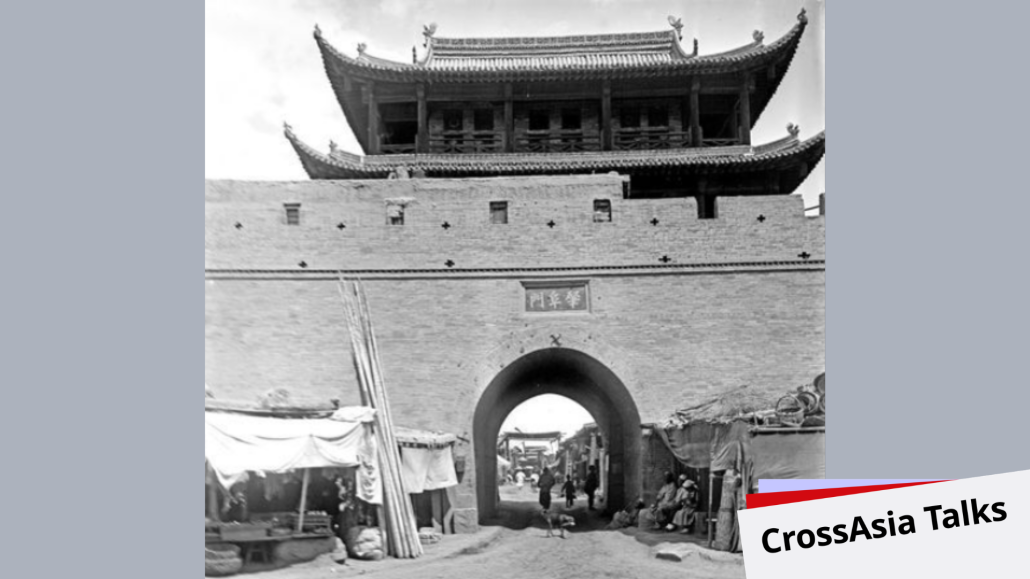
Wir freuen uns sehr, Dr. Eric Schluessel (University of Oxford) am 18.06.2026 ab 18 Uhr (Berliner Zeit) zu seinem mittlerweile zweiten CrossAsia Talk mit dem Titel The Ürümchi Mutiny of 1864: Revisiting the Muslim Uprisings and State in North Xinjiang  zu begrüßen. Während sein erster CrossAsia Talk noch hybrid stattgefunden hat, wird dieser hier eine reine Onlineveranstaltung sein.

1864 erschütterten zahlreiche Gewaltausbrüche Xinjiang. Der Vortrag deutet diese Ereignisse nicht als geheimnisvollen „muslimischen Aufstand“, sondern als Meuterei – vergleichbar mit den Geschehnissen in Indien im Jahr 1857. Durch die erneute Auswertung von Quellen in chinesischer, tschagataischer, persischer, russischer, manjurischer und arabischer Sprache, von denen viele seit über 140 Jahren von der Forschung nicht mehr herangezogen wurden, beleuchtet Eric Schluessel die sozialen und wirtschaftlichen Ursachen, die Soldaten der Grünen-Standard-Armee und ihre Familien zu gewaltsamem Protest bewegten.

In Xinjiang, Qing Central Asia, in 1864, dozens of incidents of intercommunal and anti-state violence broke out seemingly all at once. Scholars have typically referred to these events as the “Muslim uprising(s)” and attributed their origins to a vast and secret conspiracy against the empire. In fact, the leaders of these uprisings were almost all among the Qing’s most favoured and celebrated representatives in the region, including successful military leaders. This is especially the case of the violence in North Xinjiang, which we think of as being led by Sino-Muslims. This talk reexamines these events not as a mysterious “uprising,” but instead as a munity not unlike that which took place in India in 1857. By revisiting sources in Chinese, Chaghatay, Persian, Russian, Manchu, and Arabic—many of which have not been consulted by scholars in over 140 years—it establishes the social conditions that led members of the Qing’s Green Standard army and their families to engage in violent protest against changing economic policies. It retells the story of the North Xinjiang uprisings and the emergence of a Sino-Muslim-led state.

Die Vortragssprache ist Englisch. Bei Fragen kontaktieren Sie uns unter: ostasienabt@sbb.spk-berlin.de.

Der Vortrag wird via Webex gestreamt und aufgezeichnet*. Sie können am Vortrag über Ihren Browser ohne Installation einer Software teilnehmen. Klicken Sie dazu unten auf „Zum Vortrag“, folgen dem Link „Über Browser teilnehmen“ und geben Ihren Namen ein.

Zum Vortrag

Alle bislang angekündigten Vorträge finden Sie hier. Die weiteren Termine kündigen wir in unserem Blog und auf unserem Mastodon und BlueSky an.

—

We are delighted to welcome Prof. Dr. Eric Schluessel (University of Oxford) to his second CrossAsia Talk, “The Ürümchi Mutiny of 1864: Revisiting the Muslim Uprisings and the State in North Xinjiang,” on June 18, 2026, starting at 6:00 p.m. (Berlin time). While his first CrossAsia Talk was held in a hybrid format, this one will be an online-only event.

In Xinjiang, Qing Central Asia, in 1864, dozens of incidents of intercommunal and anti-state violence broke out seemingly all at once. Scholars have typically referred to these events as the “Muslim uprising(s)” and attributed their origins to a vast and secret conspiracy against the empire. In fact, the leaders of these uprisings were almost all among the Qing’s most favoured and celebrated representatives in the region, including successful military leaders. This is especially the case of the violence in North Xinjiang, which we think of as being led by Sino-Muslims. This talk reexamines these events not as a mysterious “uprising,” but instead as a munity not unlike that which took place in India in 1857. By revisiting sources in Chinese, Chaghatay, Persian, Russian, Manchu, and Arabic—many of which have not been consulted by scholars in over 140 years—it establishes the social conditions that led members of the Qing’s Green Standard army and their families to engage in violent protest against changing economic policies. It retells the story of the North Xinjiang uprisings and the emergence of a Sino-Muslim-led state.

The lecture will be held in English. If you have any questions, please contact us: ostasienabt@sbb.spk-berlin.de.

The lecture will be streamed and recorded via Webex*. You can take part in the lecture using your browser without having to install a special software. Please click on the respective button “To the lecture” below, follow the link “join via browser” (“über Browser teilnehmen”), and enter your name.

To the lecture

You can find all previously announced lectures here. We will announce further dates in our blog and on Mastodon and BlueSky.


*Mit Ihrer Teilnahme an der Veranstaltung räumen Sie der Stiftung Preußischer Kulturbesitz und ihren nachgeordneten Einrichtungen kostenlos alle Nutzungsrechte an den Bildern/Videos ein, die während der Veranstaltung von Ihnen angefertigt wurden. Dies schließt auch die kommerzielle Nutzung ein. Diese Einverständniserklärung gilt räumlich und zeitlich unbeschränkt und für die Nutzung in allen Medien, sowohl für analoge als auch für digitale Verwendungen. Sie umfasst auch die Bildbearbeitung sowie die Verwendung der Bilder für Montagen. / By participating, you grant the Stiftung Preußischer Kulturbesitz and its subordinate institutions free of charge all rights of usage of pictures and videos taken of you during this lecture presentation. This declaration of consent is valid in terms of time and space without restrictions and for usage in all media, including analogue and digital usage. It includes image processing and the usage of photos in composite illustrations. German law will apply.
Eintrag teilen
  • Teilen auf Facebook
  • Teilen auf X
  • Auf WhatsApp teilen
  • Teilen auf Pinterest
  • Teilen auf LinkedIn
  • Per E-Mail teilen
https://blog.crossasia.org/wp-content/uploads/2026/04/CrossAsia-Talks-Juni-2026.png 1080 1920 CrossAsia CrossAsia2026-06-12 10:21:372026-06-18 12:00:39CrossAsia Talks: Eric Schluessel 18.06.2026

Diskutieren Sie hierzu im CrossAsia Forum

CrossAsia Blog

  • Startseite

Themen

CrossAsia Talks

17.09.2026, Svitlana Shiells, Gustav Klimt and Hokusai: Reframing Japonisme in Fin-de-Siècle Vienna

24.09.2026, Trent Walker, Buddhist Narratives in Early Modern Southeast Asia: Insights from the Digital Library of Lao Manuscripts

26.10.2026, Philipp Kohl, Counter-Revolutionary Dinosaurs“: A Popular History of the Gobi Paleontological Expeditions under Socialism

3.12.2026, Joshua A. Fogel, Back to Babel: The Esperanto Movements in Japan and China

28.01.2027, Bolormaa Boldbaatar, Imagery in the facade decoration of the Chinggis Khan Museum – the conveyed meaning

Alle Termine

Newsletter

Nr. 37 | Juli 2026
 (HTML)

Nr. 36 | Februar 2026
 (HTML)

Nr. 35 | Oktober 2025
 (HTML)

Nr. 34 | Juli 2025
 (HTML)

Nr. 33 | Dezember 2024
 (HTML)

Nr. 32 | Juli 2024
 (HTML)

Nr. 31 | Februar 2024
 (HTML)

Nr. 30 | September 2023
 (HTML)|(PDF)

Alle Newsletter

Suche im Blog

Search Search

Recent Posts

  • Newsletter 37 – CrossAsia Sommernews: Halbjahres-Highlights und Ausblick auf einen spannenden Herbst
  • Zwei neue Datenbanken lizenziert: Church Missionary Society Archive und Missionary Studies
  • Job Opening: Bibliothekar:in (w/d/m) für Metadatenmanagement FID Asien
  • CrossAsia Talks: Svitlana Shiells 17.09.2026
  • Vortragsnachmittag Aktuelle Entwicklungen in der Mongolei

Zugang nach Datum

RSS Feed Logo RSS Feed Logo Abonnierenden RSS Feed
Link to: CrossAsia DH Lunchtalks – From Reading to Discovery: AI-Assisted Workflows for East Asian Historical Texts Link to: CrossAsia DH Lunchtalks – From Reading to Discovery: AI-Assisted Workflows for East Asian Historical Texts CrossAsia DH Lunchtalks – From Reading to Discovery: AI-Assisted Workflows...image source provided by Dr. What does it mean to be a historian in the age of AI? AI is not the first such shift. The digital turn quietly reshaped how historians work. It raised accessibility. A historian today starts a project at a search engine, pulls sources from a digital archive, and turns archive photographs into research data at home. As Ian Milligan puts it, “we are all digital now.” If the digital turn brought accessibility, AI brings something accessibility alone could not: machine reading at the scale of the archive itself. Why scale? Historical research moves through stages: reading, extracting, structuring, analyzing, visualizing, asking new questions. Each works on a single document but breaks at archive scale. The Annals of the Joseon Dynasty hold roughly 384,000 articles across five centuries. Reconstructing the careers of even one generation of officials requires linking and reasoning across more material than a single researcher can manage. In this talk I draw on several ongoing projects, including a vision-language model fine-tuned for Manchu and an agent-based record-linkage system across the Annals and the Bangmok (civil-examination rosters), to argue that AI does not replace any step in this sequence; it changes the scale at which each becomes possible. The Manchu model does not read more carefully than a Manchu specialist, but it makes an entire archive legible. The linkage system does not match identities more carefully than a historian by hand, but it tracks the same person across sources that no individual could reconcile end to end. Once reading, linkage, and structuring scale up, questions of a different order become askable: not one official’s career, but a generation’s; not one local pattern, but the structure of bureaucratic mobility across five centuries. The historian’s craft is unchanged; what changes is what becomes askable. To be a historian in the age of AI is to treat discovery, when the data itself begins to suggest the questions, as a stage of the craft. Link to: Einschränkungen bei Forschungsabteilungen | Limitations in Research Departments Link to: Einschränkungen bei Forschungsabteilungen | Limitations in Research Departments Einschränkungen bei Forschungsabteilungen | Limitations in Research Depart...
Nach oben scrollen Nach oben scrollen Nach oben scrollen
Ein Dienst der
Logo der Staatsbibliothek zu Berlin
In Zusammenarbeit mit
unseren Partnerinstitutionen
Gefördert durch
Logo Deutsche Forschungsgemeinschaft
  • ©2026 Copyright CrossAsia
  •  
  •  
  •  
  • Kontakt
  • Über CrossAsia
  • Seitenübersicht
  • Datenschutz
  • Barrierefreiheit
  • Impressum