
Sie befinden sich hier:
  • CrossAsia.org > Information > CrossAsia Blog
CrossAsia
  • Startseite
  • CrossAsia in Zahlen
  • Erwerbungskonzept
  • CrossAsia Mailingliste
  • CrossAsia Talks
  • CrossAsia Classroom
  • Regionen
  • Newsletter
  • Über CrossAsia
    • FID Asien
    • Datenmanagement
    • Suche
    • Lizenzierung
      • European Asia Licensing Initiative (EALI)
    • Kooperationspartner
    • Sammlung Ost-, Südost- und Zentralasien
    • Virtuelle Fachbibliothek Ost-, Südost- und Zentralasien (2005-2015)
    • Virtuelle Fachbibliothek Südasien (2005-2015)
    • DFG-Projekt: Aufbau einer virtuellen Forschungsumgebung für die Ostasienwissenschaften
  • Menü Menü
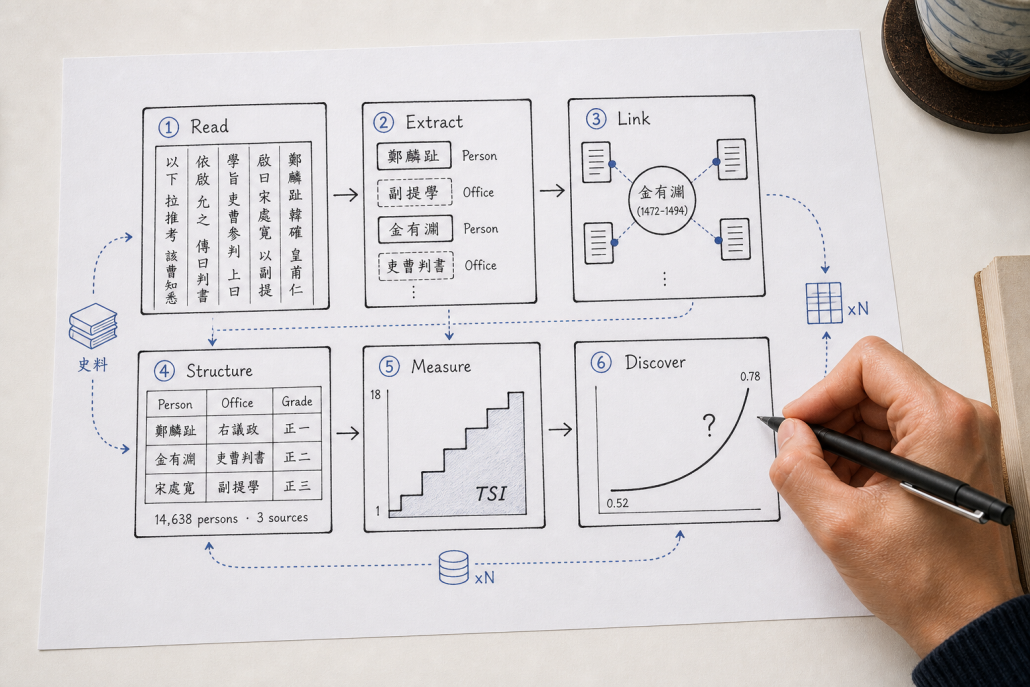
image source provided by Dr. What does it mean to be a historian in the age of AI? AI is not the first such shift. The digital turn quietly reshaped how historians work. It raised accessibility. A historian today starts a project at a search engine, pulls sources from a digital archive, and turns archive photographs into research data at home. As Ian Milligan puts it, “we are all digital now.” If the digital turn brought accessibility, AI brings something accessibility alone could not: machine reading at the scale of the archive itself. Why scale? Historical research moves through stages: reading, extracting, structuring, analyzing, visualizing, asking new questions. Each works on a single document but breaks at archive scale. The Annals of the Joseon Dynasty hold roughly 384,000 articles across five centuries. Reconstructing the careers of even one generation of officials requires linking and reasoning across more material than a single researcher can manage. In this talk I draw on several ongoing projects, including a vision-language model fine-tuned for Manchu and an agent-based record-linkage system across the Annals and the Bangmok (civil-examination rosters), to argue that AI does not replace any step in this sequence; it changes the scale at which each becomes possible. The Manchu model does not read more carefully than a Manchu specialist, but it makes an entire archive legible. The linkage system does not match identities more carefully than a historian by hand, but it tracks the same person across sources that no individual could reconcile end to end. Once reading, linkage, and structuring scale up, questions of a different order become askable: not one official’s career, but a generation’s; not one local pattern, but the structure of bureaucratic mobility across five centuries. The historian’s craft is unchanged; what changes is what becomes askable. To be a historian in the age of AI is to treat discovery, when the data itself begins to suggest the questions, as a stage of the craft.

CrossAsia DH Lunchtalks – From Reading to Discovery: AI-Assisted Workflows for East Asian Historical Texts

5. Juni 2026/in Aktuelles, CrossAsia DH Lunchtalks, Veranstaltungen/von CrossAsia

Dear users,

On June 9th at 12:30 pm (CEST), we are pleased to host the fifth session of the CrossAsia DH Lunchtalks 2026. This session will feature a presentation by Dr. Donghyeok Choi titled “From Reading to Discovery: AI-Assisted Workflows for East Asian Historical Texts.” In this talk, Dr. Choi explores how the craft of historical research is changing in the age of AI through several of his ongoing digital humanities projects focused on premodern East Asian texts. The abstract is as follows:

What does it mean to be a historian in the age of AI? AI is not the first such shift. The digital turn quietly reshaped how historians work. It raised accessibility. A historian today starts a project at a search engine, pulls sources from a digital archive, and turns archive photographs into research data at home. As Ian Milligan puts it, “we are all digital now.” If the digital turn brought accessibility, AI brings something accessibility alone could not: machine reading at the scale of the archive itself. Why scale? Historical research moves through stages: reading, extracting, structuring, analyzing, visualizing, asking new questions. Each works on a single document but breaks at archive scale. The Annals of the Joseon Dynasty hold roughly 384,000 articles across five centuries. Reconstructing the careers of even one generation of officials requires linking and reasoning across more material than a single researcher can manage.

In this talk I draw on several ongoing projects, including a vision-language model fine-tuned for Manchu and an agent-based record-linkage system across the Annals and the Bangmok (civil-examination rosters), to argue that AI does not replace any step in this sequence; it changes the scale at which each becomes possible. The Manchu model does not read more carefully than a Manchu specialist, but it makes an entire archive legible. The linkage system does not match identities more carefully than a historian by hand, but it tracks the same person across sources that no individual could reconcile end to end. Once reading, linkage, and structuring scale up, questions of a different order become askable: not one official’s career, but a generation’s; not one local pattern, but the structure of bureaucratic mobility across five centuries. The historian’s craft is unchanged; what changes is what becomes askable. To be a historian in the age of AI is to treat discovery, when the data itself begins to suggest the questions, as a stage of the craft.

About the speaker:

Dr. Donghyeok Choi is a Postdoctoral Fellow in the Department of History at Hong Kong Baptist University. He holds a Ph.D. from KAIST’s Graduate School of Culture Technology (2024) and a B.A. in History and a B.E. in Computer Science Engineering from Sungkyunkwan University. He applies computational and quantitative methods to East Asian history and builds AI-assisted research infrastructure for the humanities. He previously held a postdoctoral fellowship at the University of Hong Kong.

The lecture will be held in English. If you have any questions, please contact us at ostasienabt@sbb.spk-berlin.de.

The lecture will be streamed and recorded via Webex*. You can take part in the lecture using your browser without having to install a special software. Please click on the respective button “To the lecture” below, follow the link “join via browser,” and enter your name.

To the lecture

You can find the full programm of CrossAsia DH Lunchtalks 2026 here. Further talks will also be announced on our blog as well as on Mastodon and BlueSky.

Yours,

CrossAsia Team


*By participating, you grant the Stiftung Preußischer Kulturbesitz and its subordinate institutions free of charge all rights of usage of pictures and videos taken of you during this lecture presentation. This declaration of consent is valid in terms of time and space without restrictions and for usage in all media, including analogue and digital usage. It includes image processing and the usage of photos in composite illustrations. German law will apply.
Schlagworte: Vortragsreihe "CrossAsia DH"
Eintrag teilen
  • Teilen auf Facebook
  • Teilen auf X
  • Auf WhatsApp teilen
  • Teilen auf Pinterest
  • Teilen auf LinkedIn
  • Per E-Mail teilen
https://blog.crossasia.org/wp-content/uploads/2026/05/poster.png 1024 1536 CrossAsia CrossAsia2026-06-05 14:05:252026-06-08 11:38:48CrossAsia DH Lunchtalks – From Reading to Discovery: AI-Assisted Workflows for East Asian Historical Texts

Diskutieren Sie hierzu im CrossAsia Forum

CrossAsia Blog

  • Startseite

Themen

CrossAsia Talks

17.09.2026, Svitlana Shiells, Gustav Klimt and Hokusai: Reframing Japonisme in Fin-de-Siècle Vienna

24.09.2026, Trent Walker, Buddhist Narratives in Early Modern Southeast Asia: Insights from the Digital Library of Lao Manuscripts

26.10.2026, Philipp Kohl, Counter-Revolutionary Dinosaurs“: A Popular History of the Gobi Paleontological Expeditions under Socialism

3.12.2026, Joshua A. Fogel, Back to Babel: The Esperanto Movements in Japan and China

28.01.2027, Bolormaa Boldbaatar, Imagery in the facade decoration of the Chinggis Khan Museum – the conveyed meaning

Alle Termine

Newsletter

Nr. 37 | Juli 2026
 (HTML)

Nr. 36 | Februar 2026
 (HTML)

Nr. 35 | Oktober 2025
 (HTML)

Nr. 34 | Juli 2025
 (HTML)

Nr. 33 | Dezember 2024
 (HTML)

Nr. 32 | Juli 2024
 (HTML)

Nr. 31 | Februar 2024
 (HTML)

Nr. 30 | September 2023
 (HTML)|(PDF)

Alle Newsletter

Suche im Blog

Search Search

Recent Posts

  • Newsletter 37 – CrossAsia Sommernews: Halbjahres-Highlights und Ausblick auf einen spannenden Herbst
  • Zwei neue Datenbanken lizenziert: Church Missionary Society Archive und Missionary Studies
  • Job Opening: Bibliothekar:in (w/d/m) für Metadatenmanagement FID Asien
  • CrossAsia Talks: Svitlana Shiells 17.09.2026
  • Vortragsnachmittag Aktuelle Entwicklungen in der Mongolei

Zugang nach Datum

RSS Feed Logo RSS Feed Logo Abonnierenden RSS Feed
Link to: Neue Lizenzen: Korea Pro Link to: Neue Lizenzen: Korea Pro Neue Lizenzen: Korea Pro Link to: CrossAsia Talks: Eric Schluessel 18.06.2026 Link to: CrossAsia Talks: Eric Schluessel 18.06.2026 CrossAsia Talks: Eric Schluessel 18.06.2026
Nach oben scrollen Nach oben scrollen Nach oben scrollen
Ein Dienst der
Logo der Staatsbibliothek zu Berlin
In Zusammenarbeit mit
unseren Partnerinstitutionen
Gefördert durch
Logo Deutsche Forschungsgemeinschaft
  • ©2026 Copyright CrossAsia
  •  
  •  
  •  
  • Kontakt
  • Über CrossAsia
  • Seitenübersicht
  • Datenschutz
  • Barrierefreiheit
  • Impressum