
CrossAsia Talk: Forrest McSweeney 20.06.2024
(See English below)
Im Rahmen seines Projektes „Medicine at Arms: Medicine, the State, and the Military in Imperial and Republican China“ forscht unser Referent Herr Forrest McSweeney als SPK-Stipendiat an der Staatsbibliothek zu Berlin in der Ostasienabteilung. Er wird das Thema am Donnerstag, den 20.06.2024, ab 18 Uhr in seinem Vortrag „Military Medical Legacy: The Impact of Military Drug Distribution on the Pharmaceutical Field in Qing and Early Republican China“ genauer vorstellen. Der Vortrag wird über Webex gestreamt.
This presentation will focus on the impact of military drug distribution in the 18th century high-Qing on medical discourse and practice through the 19th century and into the Republican Period. The period from the late 18th to early 19th century was one of continued territorial expansion and rebellion suppression by the Qing empire under the reigns of the emperors Qianlong (1735-1796) and Jiaqing (1796-1820). To maintain the health of their soldiers, the Qing maintained a continuous pipeline of single-ingredient drugs from provincial markets to its Green Standards garrisons lüyingbing 綠營兵, particularly in rebellious areas in southern China. The Qing emperors also purchased ready-made formulas chengyao 成藥 from Beijing-based bulk pharmaceutical firms such as the Tongrentang 同仁堂 and Heniantang 鶴年堂pharmacies and distributed them as honorary conferrals to Manchu Eight Banners baqi 八旗 colonists and soldiers stationed in Xinjiang and Mongolia. Through the early Qing, the imperial state underwrote a vast subsidy to the private pharmaceutical industry, promoting both drug therapy and the products of targeted firms.
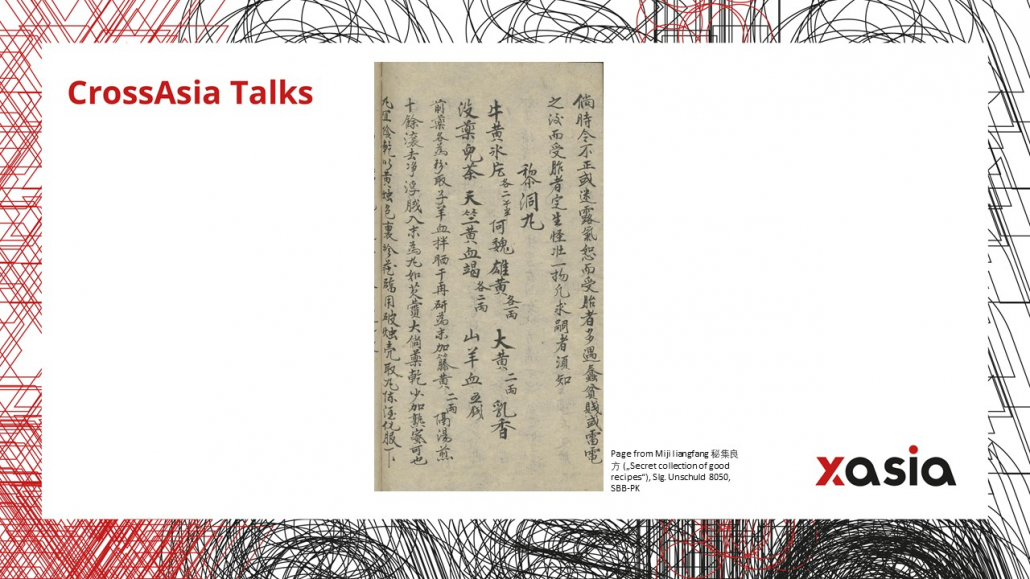
There remains several questions about these developments, though, such as what these drugs were used for? Did their soldierly use correspond to their application in larger medical discourse? Did Qing drug distribution enhance the profiles of specific drugs over those of others in medical literature? Most scholarship has tended to portray the Qing as the period when the influence of the Chinese dynastic state over medical discourse collapsed while the field of medicine in China became an unregulated free-for-all. In this talk I will go over the limitations of this interpretation. I will demonstrate the impact of military drug distribution on Qing medical publishing and explore the varied use of military formulae at the level of the individual practitioner visible in medical manuscripts at the Berlin Library. The connection between the military and medical services was so implicit by the late Qing, that military imagery was used extensively in patent medicine advertisements in the early 20th century, and the Nationalist army employed traditional herbs up to World War II.
Die Vortragssprache ist Englisch. Bei Fragen kontaktieren Sie uns unter: ostasienabt@sbb.spk-berlin.de.
Der Vortrag wird via Webex gestreamt*. Sie können am Vortrag über Ihren Browser ohne Installation einer Software teilnehmen. Klicken Sie dazu unten auf „Zum Vortrag“, folgen dem Link „Über Browser teilnehmen“ und geben Ihren Namen ein.
Alle bislang angekündigten Vorträge finden Sie hier. Die weiteren Termine kündigen wir in unserem Blog und auf unserem X-Account an.
—
As part of his research project ‘Medicine at Arms: Medicine, the State, and the Military in Imperial and Republican China’, our lecturer Mr Forrest McSweeney is a SPK fellow at the Staatsbibliothek zu Berlin at the East Asia Department. He will present his current research in more detail on Thursday, June 20, 2024, from 6 pm with the lecture ‘Military Medical Legacy: The Impact of Military Drug Distribution on the Pharmaceutical Field in Qing and Early Republican China’. The lecture will be streamed via Webex.
This presentation will focus on the impact of military drug distribution in the 18th century high-Qing on medical discourse and practice through the 19th century and into the Republican Period. The period from the late 18th to early 19th century was one of continued territorial expansion and rebellion suppression by the Qing empire under the reigns of the emperors Qianlong (1735-1796) and Jiaqing (1796-1820). To maintain the health of their soldiers, the Qing maintained a continuous pipeline of single-ingredient drugs from provincial markets to its Green Standards garrisons lüyingbing 綠營兵, particularly in rebellious areas in southern China. The Qing emperors also purchased ready-made formulas chengyao 成藥 from Beijing-based bulk pharmaceutical firms such as the Tongrentang 同仁堂 and Heniantang 鶴年堂 pharmacies and distributed them as honorary conferrals to Manchu Eight Banners baqi 八旗 colonists and soldiers stationed in Xinjiang and Mongolia. Through the early Qing, the imperial state underwrote a vast subsidy to the private pharmaceutical industry, promoting both drug therapy and the products of targeted firms.
There remains several questions about these developments, though, such as what these drugs were used for? Did their soldierly use correspond to their application in larger medical discourse? Did Qing drug distribution enhance the profiles of specific drugs over those of others in medical literature? Most scholarship has tended to portray the Qing as the period when the influence of the Chinese dynastic state over medical discourse collapsed while the field of medicine in China became an unregulated free-for-all. In this talk I will go over the limitations of this interpretation. I will demonstrate the impact of military drug distribution on Qing medical publishing and explore the varied use of military formulae at the level of the individual practitioner visible in medical manuscripts at the Berlin Library. The connection between the military and medical services was so implicit by the late Qing, that military imagery was used extensively in patent medicine advertisements in the early 20th century, and the Nationalist army employed traditional herbs up to World War II.
The lecture will be held in English. If you have any questions, please contact us: ostasienabt@sbb.spk-berlin.de.
The lecture will be streamed via Webex*. You can take part in the lecture using your browser without having to install a special software. Please click on the respective button “To the lecture” below, follow the link “join via browser” (“über Browser teilnehmen”), and enter your name.
You can find all previously announced lectures here. We will announce further dates in our blog and on X.
*Mit Ihrer Teilnahme an der Veranstaltung räumen Sie der Stiftung Preußischer Kulturbesitz und ihren nachgeordneten Einrichtungen kostenlos alle Nutzungsrechte an den Bildern/Videos ein, die während der Veranstaltung von Ihnen angefertigt wurden. Dies schließt auch die kommerzielle Nutzung ein. Diese Einverständniserklärung gilt räumlich und zeitlich unbeschränkt und für die Nutzung in allen Medien, sowohl für analoge als auch für digitale Verwendungen. Sie umfasst auch die Bildbearbeitung sowie die Verwendung der Bilder für Montagen. / By participating, you grant the Stiftung Preußischer Kulturbesitz and its subordinate institutions free of charge all rights of usage of pictures and videos taken of you during this lecture presentation. This declaration of consent is valid in terms of time and space without restrictions and for usage in all media, including analogue and digital usage. It includes image processing and the usage of photos in composite illustrations. German law will apply.


Diskutieren Sie hierzu im CrossAsia Forum