
 SBB-PK
CrossAsia Talks: Mårten Söderblom Saarela 4. August 2022
(See English below)
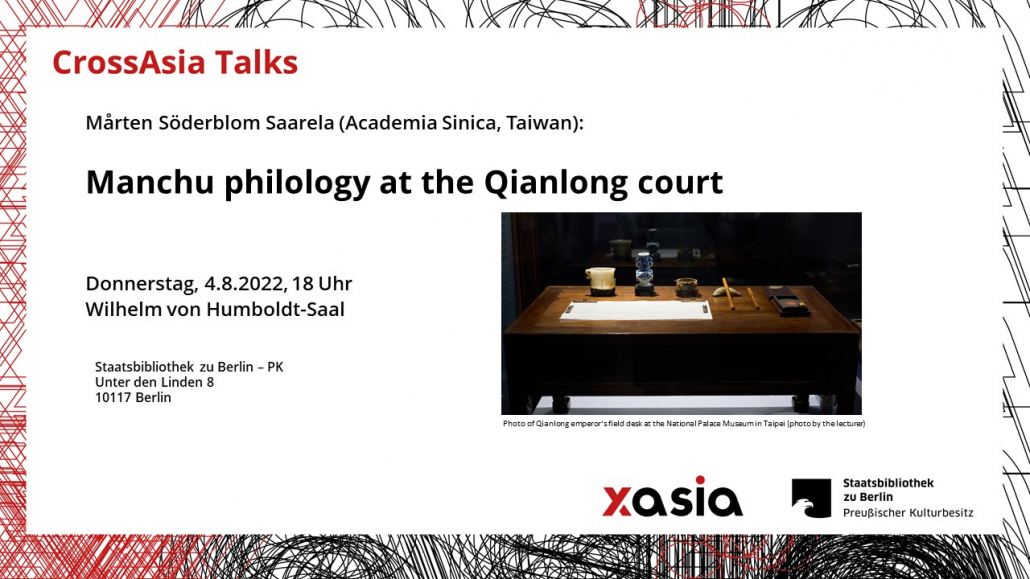
Nach der Sommerpause im Juli geht unsere Vortragsreihe „CrossAsia Talks“ am 4. August ab 18 Uhr im Wilhelm von Humboldt-Saal (Unter den Linden 8, 10117 Berlin) mit einem Vortrag von Mårten Söderblom Saarela (Academia Sinica, Taiwan) zu „Manchu philology at the Qianlong court“ weiter.
The late eighteenth century witnessed the flourishing of a brand of precise philological scholarship known as “evidential learning” (kaozheng xue or kaoju xue). In the hands of Chinese scholars from the lower Yangzi region, subjects ranging from classical learning to geography and mathematics were subjected to a first and foremost textual and historical form of research. The role of the Qing court, headed by the Manchu Qianlong emperor, in the emergence of this kind of scholarship has long been a matter of debate. Some have seen Qing imperial power as an inhibiting factor that pushed research into politically harmless discussions of textual minutiae, whereas others have recognized the importance of the court as a patron of “evidential learning.” Whatever the case, the Manchu political leadership remains on the sidelines of an ultimately Chinese project.
In this talk, I will approach the issue of court involvement in “evidential learning” from a new angle. I will look at a series of research projects that were carried out at the Qianlong court during this period, in which both the source material, the workflow, and the resulting books were wholly or partially in Manchu, not Chinese. As the Chinese textual heritage was being re-examined by lower Yangzi-luminaries, clerks and officials under the leadership of the emperor and his Manchu Grand Councilors produced three scholarly works on the oldest Manchu-language documents that existed. The archival documents from the early seventeenth century that the victorious Qing had brought with them to Beijing—fragmentary and hard to read in parts—were studied from a linguistic and historical point of view. Guided by the question of how these scholarly projects compare to Chinese “evidential learning,” I will discuss a few works from the library’s collection.
Die Vortragssprache ist Englisch. Wir bitten Sie um Voranmeldung für den Vortrag unter: ostasienabt@sbb.spk-berlin.de und eine kurze Mitteilung falls Sie einen barrierefreien Zugang benötigen. Der Vortrag wird gefilmt.*
Der Vortrag wird darüber hinaus via Webex gestreamt und aufgezeichnet. Sie können am Vortrag über Ihren Browser ohne Installation einer Software teilnehmen. Klicken Sie dazu unten auf „Zum Vortrag“, folgen dem Link „Über Browser teilnehmen“ und geben Ihren Namen ein.
Alle bereits angekündigten Vorträge finden Sie hier. Weitere Termine kündigen wir in unserem Blog und auf unserem Twitteraccount an.
—
After the summer break in July, our lecture series „CrossAsia Talks“ continues on 4 August from 6 pm in the Wilhelm von Humboldt-Saal of the Staatsbibliothek zu Berlin (Unter den Linden 8, 10117 Berlin) with a lecture by Mårten Söderblom Saarela (Academia Sinica, Taiwan) on „Manchu Philology at the Qianlong court“.
The late eighteenth century witnessed the flourishing of a brand of precise philological scholarship known as “evidential learning” (kaozheng xue or kaoju xue). In the hands of Chinese scholars from the lower Yangzi region, subjects ranging from classical learning to geography and mathematics were subjected to a first and foremost textual and historical form of research. The role of the Qing court, headed by the Manchu Qianlong emperor, in the emergence of this kind of scholarship has long been a matter of debate. Some have seen Qing imperial power as an inhibiting factor that pushed research into politically harmless discussions of textual minutiae, whereas others have recognized the importance of the court as a patron of “evidential learning.” Whatever the case, the Manchu political leadership remains on the sidelines of an ultimately Chinese project.
In this talk, I will approach the issue of court involvement in “evidential learning” from a new angle. I will look at a series of research projects that were carried out at the Qianlong court during this period, in which both the source material, the workflow, and the resulting books were wholly or partially in Manchu, not Chinese. As the Chinese textual heritage was being re-examined by lower Yangzi-luminaries, clerks and officials under the leadership of the emperor and his Manchu Grand Councilors produced three scholarly works on the oldest Manchu-language documents that existed. The archival documents from the early seventeenth century that the victorious Qing had brought with them to Beijing—fragmentary and hard to read in parts—were studied from a linguistic and historical point of view. Guided by the question of how these scholarly projects compare to Chinese “evidential learning,” I will discuss a few works from the library’s collection.
The lecture will be held in English. We kindly ask you to register in advance at: ostasienabt@sbb.spk-berlin.de, and to let us know if you need barrier-free access. The event will be filmed.*
The lecture will also be streamed and recorded via Webex. You can take part in the lecture using your browser without having to install a special software. Please click on the respective button “To the lecture” below, follow the link “join via browser” (“über Browser teilnehmen”), and enter your name.
You can find all previously announced lectures here. We will announce further dates in our blog and on Twitter.

