
 Eric Schluessel
The World of a Nineteenth-Century Uyghur Village
Eric Schluessel (Ph.D.) ist Sozialhistoriker und widmet sich in seiner Forschung vor allem der Region Xinjiang (Chinesisch Zentralasien) im 19. und 20. Jh. Derzeit ist er als Assistant Professor of History and International Affairs an der George Washington University tätig. Im Sommer 2021 hielt er sich als Stipendiat im Rahmen des Stipendienprogramms der Stiftung Preußischer Kulturbesitz an der Staatsbibliothek zu Berlin auf und studierte vormoderne Handschriften aus Xinjiang. In diesem Blogpost gibt er einen kurzen Einblick in seine Forschung an der SBB.
The homeland of the Uyghur people now appears constantly in the news. This region in Northwestern China, called “Xinjiang” in Chinese, is a vast land of mountains, deserts, oases, and grasslands. Its autochthonous majority, known today as Uyghurs, speak a language related to Turkish and mainly practice Islam. Their homeland was incorporated into the China-based Qing empire in the 1750s, and the tension between Turko-Islamic and Chinese or Confucian cultures has shaped interactions between communities in the region ever since.
That tension is highly apparent in historical scholarship, which has tended to focus on the politics of Uyghur ethnic identity over the past two hundred years, for example the question of the origins of Uyghur nationalism. That is to say, the present issue of interethnic and religious conflict has helped define how historians think about the Uyghur past and select research topics.
In the midst of tragedy and politics, how can we remember that history is also the story of ordinary people? The history of everyday life is a powerful thing. It humanizes people in distant places and times by showing how their struggles and daily victories reflect our own. Now a pair of remarkable historical documents from villages in the Uyghur homeland at the Staatsbibliothek zu Berlin (SBB) are opening new windows into that history of everyday life by illuminating economic history at the village level.
The documents both arrived at SBB thanks to the archaeologist Georg Huth (1867–1906). In 1902, Huth traveled with a German expedition to the Uyghur homeland, specifically to the oasis of Turfan. There, in the town of Qarakhoja, he purchased a number of manuscripts written in Chaghatay, the literary language of which modern Uyghur is an immediate descendant. Following his death, those manuscripts were given to SBB. There, one key manuscript was cataloged but largely ignored, and another was forgotten about entirely until 2019, when Dr. Aysima Mirsultan, a librarian at SBB and expert in the history of the Turkic world, noticed it in the library’s vaults.
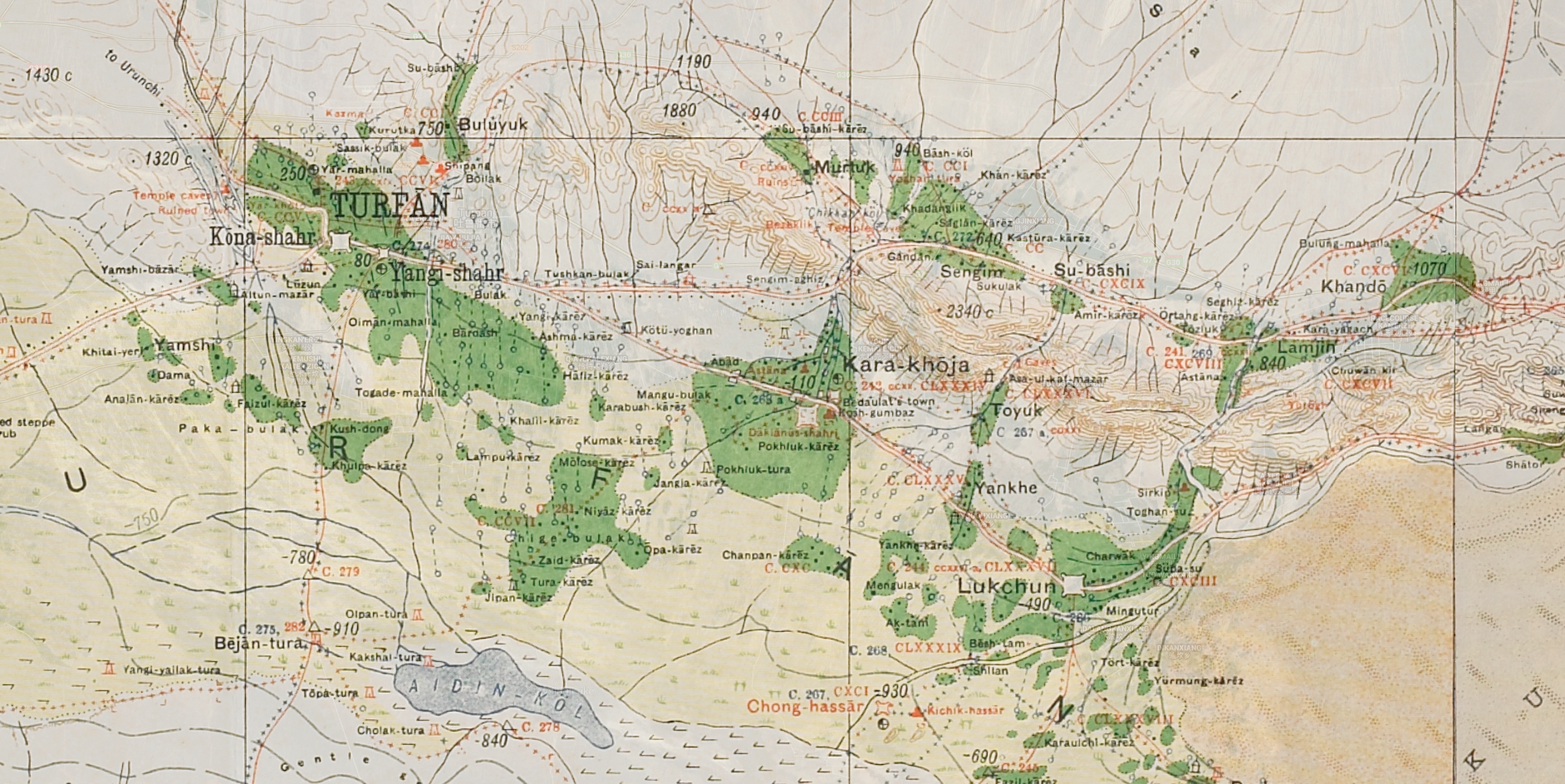
Figure 1 : An excerpt from Aurel Stein’s maps of the Uyghur homeland, indicating the oasis of Turfan and town of Qarakhoja (“Kara-khōja”)
Those manuscripts, along with many other sources that have recently come to light, show how Uyghurs conceived of and undertook economic activities at the village level, and even used the institutions of the Qing empire to stabilize prices and provide relief to those affected by disasters. One manuscript, Ms. or. fol. 3303, is a notebook kept by a merchant who sold cloth, leather, and fur. It dates to 1895, which was a complicated year for the Uyghur homeland’s economy, as the Qing empire was withdrawing the subsidies that kept the Xinjiang government afloat. The other manuscript, the recently discovered Ms. or. fol. 4221, is actually a collection of ten notebooks dating to around the same time. These notebooks describe the activities of the “relief granary,” a special Chinese institution used to balance market prices for vital commodities by collecting grain and releasing it strategically onto the market.
I get the feeling that the merchant’s notebook (Ms. or. fol. 3303) received so little scholarly attention in part because the handwriting is so difficult to decipher. When we read it, we get a sense of a merchant with several apprentices, each of whom writes with different handwriting and spelling. One of them—the merchant himself, I think—had a clear and educated hand and favored a reed pen, while his underlings scrawled in ink or pencil, sounding words out letter-by-letter. Even common words can be difficult to decipher, let alone the obscure terminology related to cloth and leather. Many Chinese words also appear, but these are written in Arabic letters instead of Chinese characters, adding to the confusion.

Figure 2: A page from Ms. or. fol. 3303, showing the different “hands” that wrote in this notebook. Each entry is enclosed in a bubble.
Nevertheless, once we decipher the handwriting, the information within gives us an unprecedented picture of artisans and merchants in Turfan. We even see examples of women’s roles in production and the market. Several named women purchased cloth and other materials from the shop, and then returned later on to sell back the hats they had made. These colorful four-cornered skullcaps, called doppa, are a mainstay of Uyghur dress to this day. Let us consider the example of a woman named Harnisa:
Harnisa purchased 1 foot 3 inches of velvet at .8 silver coins.
Embroidered 12 doppas for us. Borrowed 8 silver. Purchased 1
spool of thread and ½ of cotton matting at .13 silver. Purchased 1
gold coin’s worth of black felt, 1 gold coin’s worth of soap.
Embroidered 3 brocade doppas for us. Embroidered 5 more
brocade doppas for us. Embroidered 5 more brocade doppas for
us. Purchased 1 piece of woven cotton cloth at .35 silver.
Embroidered 4 velvet doppas for us.
Clearly, Harnisa was a regular customer with a longstanding relationship with the shop. She was not alone – many other craftspeople, such as milliners and cobblers, also made bulk purchases from the shop every month. Other customers bought items for personal use: A shirt, or a headscarf, or perhaps an exceptionally fine robe that might be given as a wedding gift.
We can also tell from these entries more or less how much material it took to create a doppa. Indeed, the listed items are all part of a doppa: velvet, brocade, thread, cotton matting for the interior, and soap to stiffen the cloth. One of those components, gold brocade, was the single most expensive item in the shop, sold at 1.25 silver per inch. (To put it in context, the same notebook states that the price of a loaf of bread was .1 silver.) But Harnisa did not buy her brocade from this shop—perhaps she found a better price elsewhere?
As we look more closely at the merchant’s notebook, families begin to appear: Amrullah the Baker paid his bills in bread, and sometimes his wife, Sherin, brought a few loaves to pay her bills, as well. Fathers, sons, and brothers regularly stopped by to pay each other’s debts, or to purchase gifts for one another. In the future, mapping these relationships will help enrich our understanding of how people organized themselves as families and as workers.
The collection of notebooks from the relief granary (Ms. or. fol. 4221) finally provide some context for the merchant’s records. These notebooks are also written in Chaghatay, but the scribes mainly favored the tools of Chinese writing, such as ink brushes that seem to have been poorly suited to writing the Arabic script. This means that the notebooks are written in a spidery handwriting that takes much practice to read, as well as a kind of shorthand derived from the choppy, dense grammar of Chinese documents. Not to mention, they also use many Chinese words!
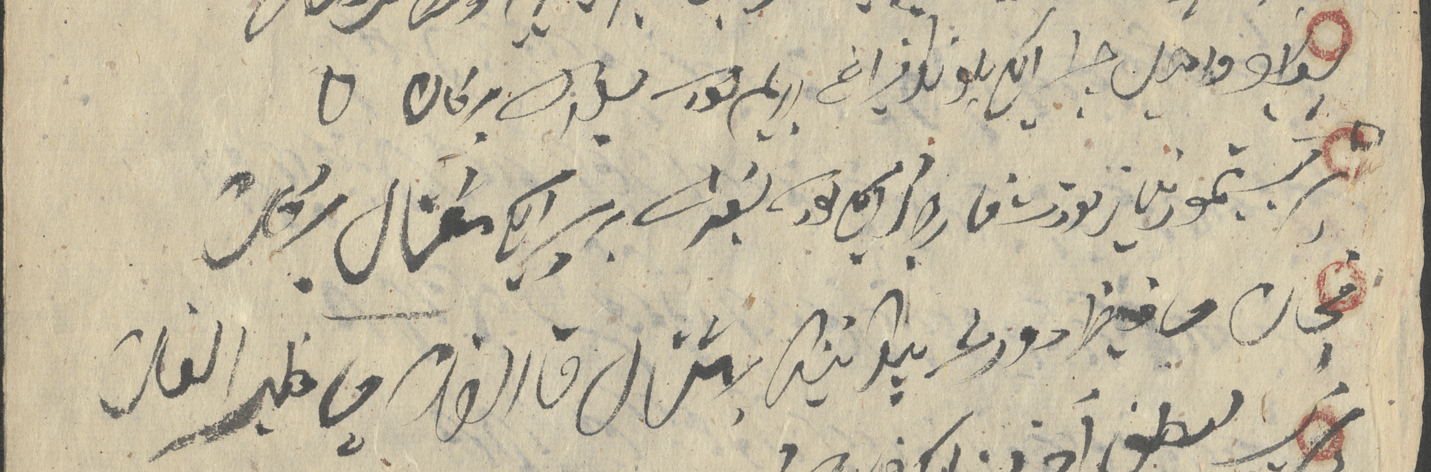
Figure 3: Text from Ms. or. fol. 4221
Ongoing work on the relief granary notebooks, however, is revealing much about how the Qing state in its local form understood not only the prices of goods, but the value of other things: The notebooks record prices for a day of labor, an hour of water to irrigate one’s field, a small amount of tobacco, and other things that were part of the daily exchanges between ordinary people. Gradually, as it becomes possible to identify the many individuals named in these notebooks, and to compare other documents that describe their landholdings and professions, the world of an Uyghur village in the nineteenth century will come to life.
 SBB-PK