
Small Forms in a Long Malay Romance: The Berlin Manuscript of Hikayat Dewa Mandu
Gastbeitrag von Dr. Kris Ramlan
“Seven of you, and I alone.” With this playful challenge, Angkaran Dewa, companion to the hero of a Malay romance, invites the princess’s attendants to a contest in verse. The princess smiles and urges them to answer. Dang Areka Warna draws her bow across the rebab, a bowed string instrument, and replies with a teasing four-line poem. Music, teasing and verbal skill converge in a few lines of a handwritten copy of the story preserved at the Staatsbibliothek zu Berlin (SBB).
Such exchanges became the focus of my two-month research residency at the SBB in 2026, supported by the Stiftung Preußischer Kulturbesitz Research Grant Programme. In the Berlin manuscript of Hikayat Dewa Mandu, passages of embedded verse allow characters to tease, console, challenge and persuade one another. Yet their presence on the page is uneven. Red marks distinguish some passages of verse, while elsewhere the writing continues in black ink without a clear break. The project therefore examined how verse is made recognisable within prose and how its meaning emerges from the exchanges in which it occurs.
The manuscript and its pantun
My research at the SBB began with a broader study of pantun and syair, two Malay poetic forms commonly composed in quatrains and transmitted through both performance and writing. The programme’s theme, “Small Forms – Between Materiality, Mediality, and Genre”, offered a framework for considering their brevity, portability and manuscript presentation.
Direct work with the collection gradually centred the project on Hikayat Dewa Mandu, SBB Ms. or. fol. 404. In the Malay literary tradition, hikayat refers broadly to prose narratives, often involving royal courts, adventure, romance and encounters with the supernatural. This long romance follows Dewa Mandu through separation, courtship and warfare, including his relationship with the princess Lela Ratna Kumala, before culminating in the recognition of his royal identity and enthronement. Throughout the story, characters repeatedly turn to pantun.
A pantun usually consists of four lines with alternating rhyme. Its opening two lines often present an image from everyday life or the natural world, while the closing two turn towards a thought, feeling or social situation. Sound, suggestion and association connect the two parts. In dialogue, a speaker may also take up a word, image or rhyme from the preceding quatrain and reshape it into a reply.
The story circulated widely across the Malay literary world and beyond. Henri Chambert-Loir’s critical edition (1980) was based principally on one Malay manuscript and comparison with fourteen others, all nineteenth-century witnesses. He considered the story itself much older, possibly reaching back to the fifteenth century. Javanese translations and the Cham verse adaptation Akayet Deva Mano show that the narrative also travelled across languages and literary forms.
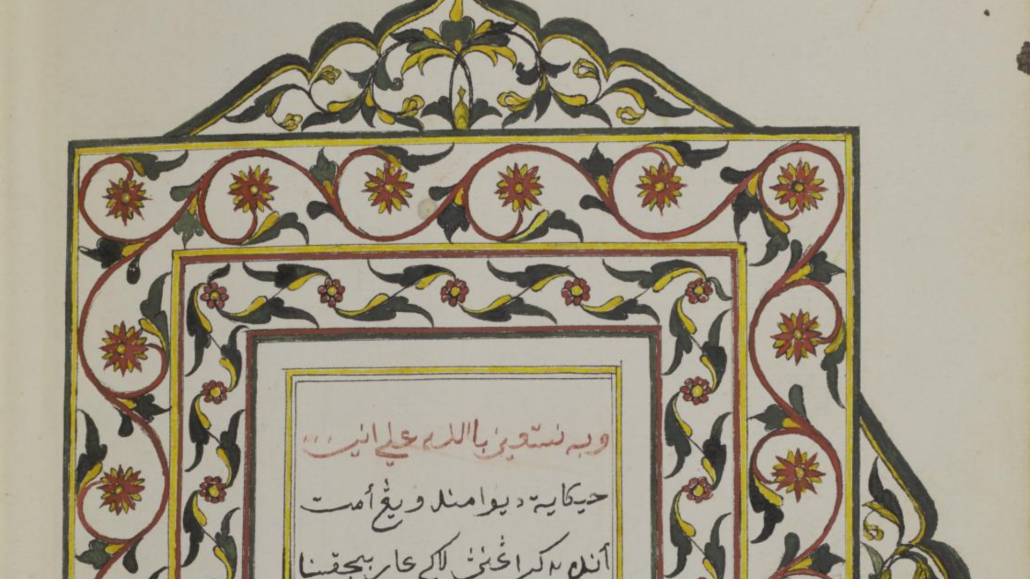
This codex contains 286 numbered pages, preceded by a two-page decorated frontispiece. It is written in Jawi, the Arabic-derived script used for Malay, generally with 21 lines to a page. Its paper bears a watermark dated 1809, providing an earliest possible date for the copying. Neither the scribe nor a completion date is named.
The relationship between the long narrative and the small forms embedded within it became central to the project. A single pantun may condense a feeling, challenge or response, while a sequence can build an extended exchange. Each pantun has a material presence on the page, a voice within the narrative and a recognisable poetic form. In this sense, the Berlin manuscript brings materiality, mediality and genre into close relation.
What the red ink reveals
Chambert-Loir’s critical edition presents the pantun as clearly separated quatrains. In the Berlin manuscript, the visual boundaries are less regular. Verse often continues within the same block of writing as prose. A poetic line need not coincide with a line of manuscript writing, and a quatrain may end without a blank space. The shift from prose to verse can therefore depend on signals beyond layout.
Red ink, or rubrication, provides one set of signals. On page 56, red marks identify parts of a pantun exchange without consistently distinguishing every poetic line. On page 59, the marking is more systematic. A red sign marks each poetic line, although the quatrains remain within the continuous text block.
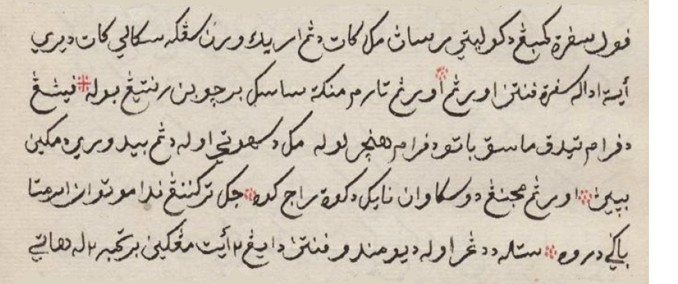
Figure 1. Red marks identify parts of a pantun exchange about remembered longing, but do not consistently distinguish each poetic line. Hikayat Dewa Mandu, Ms. or. fol. 404, p. 56 [image 69], Staatsbibliothek zu Berlin – Preußischer Kulturbesitz. Bracketed image numbers refer to the full digital image sequence. Digital image via Qalamos/Mirador. Detail selected by the author.
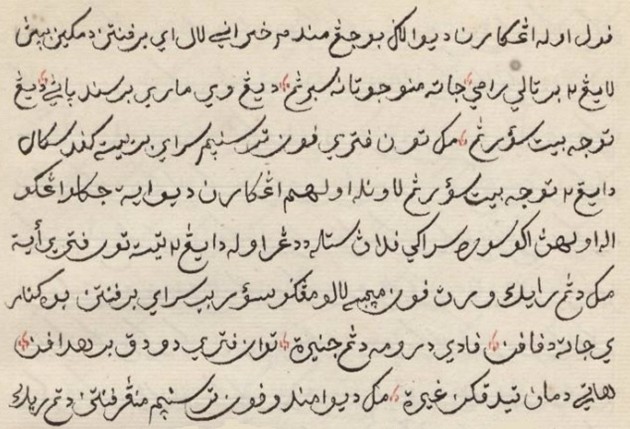
Figure 2. Red marks distinguish each poetic line in a courtly pantun contest, while the quatrains remain within the continuous text block. Hikayat Dewa Mandu, Ms. or. fol. 404, p. 59 [image 72], Staatsbibliothek zu Berlin – Preußischer Kulturbesitz. Digital image via Qalamos/Mirador. Detail selected by the author.
Red ink also marks prose openings and transitions, so rubrication cannot be treated as a consistent marker of poetry. I compared these passages with two other digitised copies of Hikayat Dewa Mandu and two early witnesses of Hikayat Isma Yatim, another Malay prose narrative rich in embedded verse. In the passages examined, I found no comparable rubrication. This limited comparison cautions against treating the Berlin practice as representative of the wider tradition.
The language used to introduce poetic speech provides another cue. The narrative uses terms such as berpantun (speaking in pantun), bersyair (reciting syair) and bernyanyi (singing), alongside a wider vocabulary of song and stylised speech. Earlier Malay literary terminology was often more fluid and situational than the distinctions familiar from modern literary handbooks. Terms for poetic form, vocal delivery, emotional register and social occasion can overlap without becoming interchangeable. A pantun may therefore remain recognisable from its formal pattern and narrative context even when neither rubrication nor an explicit genre label sets it apart from prose.
A contest in which every word counts
The exchange on page 59 shows why these pantun need to be read as part of a sequence. The Malay passages below follow my transcriptions, with punctuation added. English translations follow each passage. Angkaran Dewa sings.
Layang-layang bertali rami,
Jatuh menuju tanah seberang,
Dayang wai, mari bersindir nyanyi,
Dayang tujuh beta seorang!
A kite with a ramie string,
Falling towards the farther shore,
Come, maidens, trade teasing songs,
Seven of you, and I alone!
At the princess’s encouragement, Dang Areka Warna takes up the challenge.
Buah kenari jatuh di papan,
Padi di rumah Dang Jenirat,
Tuan puteri duduk berhadapan,
Hati di mana tidakkan ghairat?
A kenari fruit falls on the board,
Rice is in Dang Jenirat’s house,
The princess sits here face to face,
What heart would not stir with ardour?
In both quatrains, concrete images in the opening lines lead into the social and emotional situation of the closing couplet. Much of the connection depends on sound and association and is difficult to reproduce in translation. In Angkaran Dewa’s quatrain, for example, seberang (“farther shore”) rhymes with seorang (“alone”).
Dang Areka Warna redirects the challenge. Angkaran Dewa has presented himself as one man facing seven attendants. She turns attention instead to the princess seated before him. The word ghairat (“ardour”) makes that visual and social proximity part of the teasing. As the contest continues, speakers reuse words from preceding quatrains and turn them towards new meanings. In one later reply, Dang Jenirat reuses several words from Angkaran Dewa’s preceding pantun before ending with the mocking question, “Why have you no beard?” The wit depends on memory, quick response and the ability to turn an opponent’s words to a new purpose.
The scene also shows how mediality operates within the narrative. Angkaran Dewa first strikes up a tune, while Dang Areka Warna answers as she plays the rebab. The princess and attendants listen and judge the contest. Written verse is therefore embedded in a scene of voice, music and social interaction. These descriptions of performance help signal poetic speech, but they do not establish how this particular codex was read aloud or whether it functioned as a performance script.
When longing becomes action
and stars illuminate the palace grounds, while a gentle breeze carries the fragrance of flowers. Dewa Mandu, separated from Lela Ratna Kumala, begins to sing in an attempt to console himself. His quatrain ends with these lines.
Ayo Allah matikan aku,
Tidak kuasa duduk bercinta.
O God, take my life,
I can no longer bear this longing and sorrow.
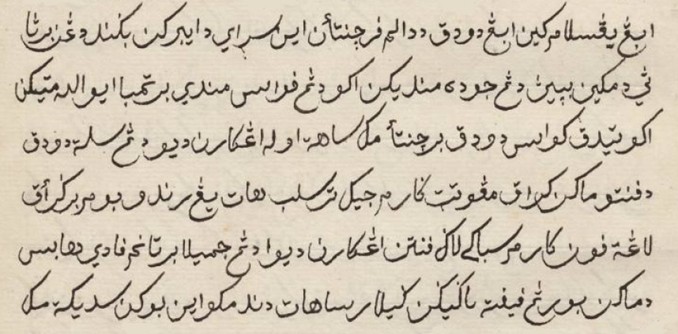
Figure 3. A lament and its replies are copied entirely in black ink, with no red marks distinguishing verse from prose. Hikayat Dewa Mandu, Ms. or. fol. 404, p. 68 [image 81], Staatsbibliothek zu Berlin – Preußischer Kulturbesitz. Digital image via Qalamos/Mirador. Detail selected by the author.
A different pair of pantun on page 66 brings affection and obligation together.
Hutang emas boleh terbayar,
Hutang kasih seumur hidup.
A debt of gold can be repaid,
A debt of love lasts a lifetime.
Here kasih is broader than romantic love. It can encompass affection, care and favour, and in this context it also carries an expectation of reciprocation. The next quatrain takes up two lines from the first, including Hutang kasih seumur hidup, and closes by offering body and life in repayment. In the surrounding prose, Lela Ratna Kumala remembers Dewa Mandu’s willingness to risk his life to bring her home. The vocabulary of poetic reply also carries a sense of moral reciprocity. Balas refers to answering the preceding pantun, but it can also express the obligation to repay kasih or budi.
Together, these scenes show why embedded pantun need to be read alongside the speech and action that surround them. Their narrative force often becomes clear through what follows, which may be another pantun, a remembered act, a decision or a bodily response. Even without an answering quatrain, the prose may record the listener’s compassion, tears or bodily reaction.
Extending the Berlin research
During the residency, I transcribed 81 quatrains in 18 exchanges. Further work expanded the corpus to 106 quatrains across 25 episodes. Seventeen episodes involve two or more voices exchanging verse, while eight contain pantun spoken by a single character. The predominance of exchange reinforces the importance of reading each pantun with the speech that prompts it and the response that follows.
I presented the expanded study at the Fourth International Seminar on Malay Manuscripts (SEMALU IV), held at Universiti Kebangsaan Malaysia on 21 July 2026. The paper also examined selected older Malay lexical usages preserved in the manuscript.
The manuscript’s digital images, available through Qalamos and IIIF, also open possibilities for substantial collaborative philological work beyond the reading room. Researchers working in different locations could use the same manuscript images to compare difficult readings, develop transcriptions and annotations, examine older lexical forms and discuss alternative interpretations. Image-linked work could also make editorial decisions more transparent by showing where poetic lines that run together on the manuscript page have been separated in transcription or edition. Comparison with other manuscript copies and language versions could further trace changes in wording, sequence and presentation.
The Berlin research shows what can be obscured when embedded pantun are detached from the manuscript page and the narrative exchanges in which they occur. Modern page layout can obscure features of the manuscript’s presentation, while an isolated quotation can lose the challenge, reply or action that gives it force. Reading the page together with the scene brings those relationships back into view. In Hikayat Dewa Mandu, a four-line pantun can give form to feeling, provoke a reply and redirect an encounter.
I am grateful to the SBB team, especially Claudia Götze-Sam, Tristan Hinkel, Thoralf Hanstein and Heinz-Jürgen Bove, whose guidance and assistance supported this work.
References
Chambert-Loir, Henri. 1980. Hikayat Dewa Mandu: Épopée malaise I. Texte et présentation. Paris: École française d’Extrême-Orient.
Muhammad Haji Salleh. 2011. “In Search of Literary Love in Malay Literature: The Early Stages of Relationship.” Asiatic 5 (2): 17–39.
Frau Dr. Kris Ramlan, Goethe Universität Frankfurt, war im Rahmen des Stipendienprogramms der Stiftung Preußischer Kulturbesitz im Jahr 2026 als Stipendiatin an der Staatsbibliothek zu Berlin. Forschungsprojekt: „Embedded Pantun, Rubrication, and Small Forms in Hikayat Dewa Mandu“

Diskutieren Sie hierzu im CrossAsia Forum