
CrossAsia Talks: Beate Löffler 11.02.2027
(See English below)
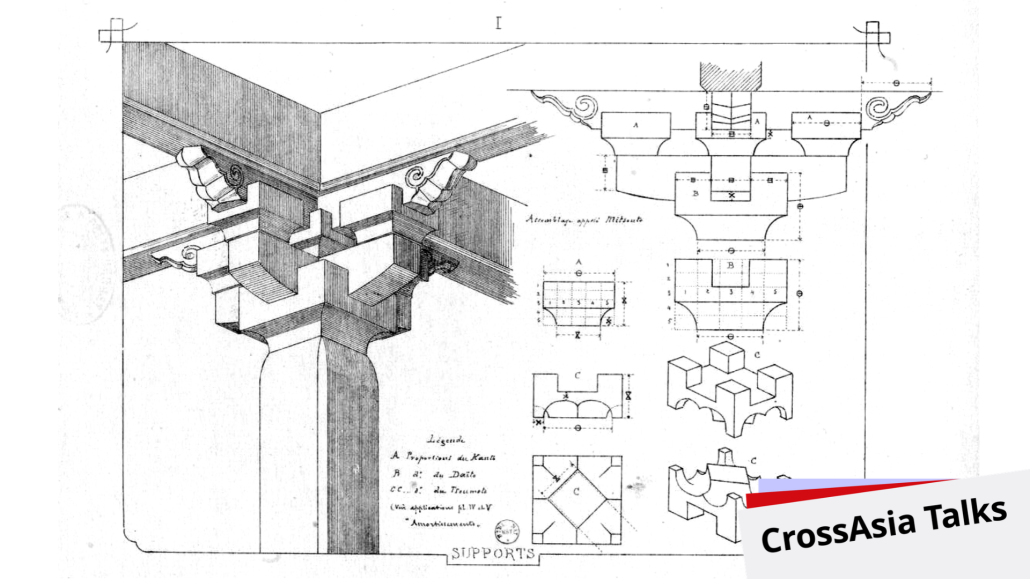
Wie in der Zeit des Japonismus im Westen ein Bild japanischer Architektur transportiert und geschaffen wurde, beleuchtet PD Dr. Beate Löffler (TU Dortmund) in ihrem Onlinevortrag “Japanische Architektur im Bild. Eine quellenkritische Betrachtung zum späten 19. Jahrhundert” am 11. Februar 2027 ab 18 Uhr (Berliner Zeit).
Der Japonismus, also der Einfluss japanischer Kultur auf die euroamerikanische Kunst seit dem späten 19. Jahrhundert, ist ein bekanntes und intensiv erforschtes Beispiel für kulturelle Transferprozesse. Er wuchs aus dem Handel mit und dem Sammeln von Objekten, den Diskursen über diese Objekte und ihre Herkunft sowie aus der künstlerischen Inspiration, die aus der Auseinandersetzung mit diesen Objekten und Ideen hervorging.
Für Architektur funktioniert dieser Zugang nur bedingt: Architektur ist immobil und kann nicht gesammelt werden. Damit benötigen sowohl der grundlegende Informationstransfer als auch die Diskussion über die Inhalte die Hilfe medialer Übersetzungen wie Beschreibungen, Skizzen, Fotos oder Modelle. Der Vortrag betrachtet, wie dies im späten 19. Jahrhundert bewältigt wurde.
Der Vortrag konzentriert sich auf Bildmaterialien als Informationsquellen und betrachtet vor allem die Illustrationspraxis in Büchern und Zeitungsartikeln. Dabei interessiert zunächst, welche Materialien (Zeichnungen, Fotos und Holzschnitte) grundsätzlich verfügbar waren, welche Auswahl daraus tatsächlich eingesetzt wurde und welches ‚Bild‘ der japanischen Architektur damit erzeugt wurde. Darüber hinaus wird hinterfragt, welche zusätzlichen Materialien hätten herangezogen werden können und warum diese nicht genutzt wurden und werden.
Die Vortragssprache ist Deutsch. Bei Fragen kontaktieren Sie uns unter: ostasienabt@sbb.spk-berlin.de.
Der Vortrag wird via Webex gestreamt*. Sie können am Vortrag über Ihren Browser ohne Installation einer Software teilnehmen. Klicken Sie dazu unten auf „Zum Vortrag“, folgen dem Link „Über Browser teilnehmen“ und geben Ihren Namen ein.
Alle bislang angekündigten Vorträge finden Sie hier. Die weiteren Termine kündigen wir in unserem Blog und auf unserem Mastodon-Account und BlueSky an.
—
In her online lecture “Japanese Architecture in Images: A Critical Examination of Sources from the Late 19th Century” , on 11 February 2027 from 6 pm (Berlin time), PD Dr. Beate Löffler (Technical University of Dortmund) sheds light on how an image of Japanese architecture was conveyed and created in the West during the era of Japonism.
Japonism – that is, the influence of Japanese culture on Euro-American art since the late 19th century – is a well-known and extensively researched example of cultural transfer processes. It grew out of the trade in and collection of objects, the discourses about these objects and their origins, and the artistic inspiration arising from engagement with these objects and ideas.
In the case of architecture, this approach is only of limited use: architecture is immovable and cannot be collected. Consequently, both the fundamental transfer of information and the discussion of this information require the aid of media-based translations such as descriptions, sketches, photographs or models. This lecture examines how this was achieved in the late 19th century.
The lecture focuses on visual materials as sources of information and examines, in particular, the practice of illustration in books and newspaper articles. The initial focus is on which materials (drawings, photographs and woodcuts) were generally available, which of these were actually selected for use, and what ‘image’ of Japanese architecture was thereby created. Furthermore, the lecture explores which additional materials could have been drawn upon and why these were not, and are not, utilised.
The lecture will be held in German. If you have any questions, please contact us: ostasienabt@sbb.spk-berlin.de.
The lecture will be streamed via Webex*. You can take part in the lecture using your browser without having to install a special software. Please click on the respective button “To the lecture” below, follow the link “join via browser” (“über Browser teilnehmen”), and enter your name.
You can find all previously announced lectures here. We will announce further dates in our blog and on Mastodon and BlueSky.

Diskutieren Sie hierzu im CrossAsia Forum