
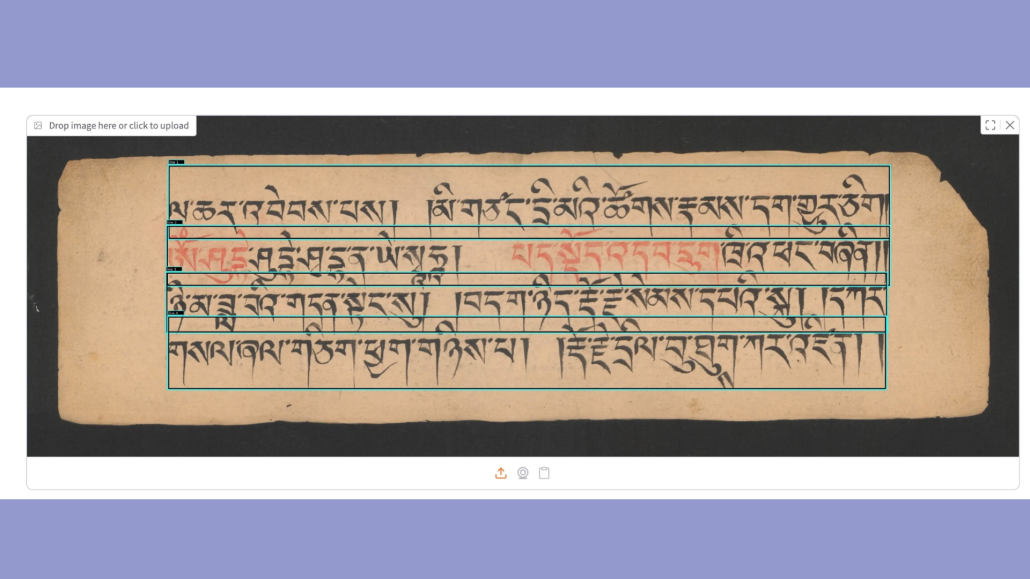
Old Tibetan Prints, New Digital Access: PechaBridge and the Digital Collections at Stabi
Gastbeitrag von Dr. Nico Mothes, Dirk Tilger and Theresa Scherling
Digitization makes historical Tibetan pecha prints visible online, but visibility alone does not make their content readable, searchable, or reusable for research. PechaBridge is an open-source pipeline connecting digitized materials from the Staatsbibliothek zu Berlin with layout analysis, Tibetan OCR, metadata, and review tools.
From Digitized Pages to Researchable Text
Historical pecha pages differ substantially from modern book pages. Their horizontal format, paper texture, red and black ink, annotations, uneven baselines, and varying states of preservation challenge standard OCR.
A useful transcription must remain connected to the original image, its position within the digitized object, the catalogue record, and the processing configuration that produced it.
PechaBridge grew out of the November 2024 CrossAsia hackathon on layout recognition for Tibetan manuscripts and block prints, organized by Cloud & Heat in cooperation with SAXONY.ai and AI Insights Saxony. CrossAsia contributed the use case and examples from the Staatsbibliothek zu Berlin’s Tibetan collections. Dr. Nico Mothes, Dirk Tilger, and Theresa Scherling have since continued the project in their spare time as an open-source initiative.
Development takes place in close exchange with Kristin Mothes, a doctoral researcher in Tibetan Studies, and Antje Ziemer, subject specialist at the Staatsbibliothek zu Berlin, helping align the software with philological and library requirements.
From Stabi Object to Reviewable OCR
PechaBridge uses the Pica Production Number, or PPN, of a digitized object to retrieve page images and metadata from the SBB digital collections. Through the library’s IIIF-based image delivery, pages can be downloaded in their original order. A metadata.json file links each page to bibliographic information and its source URL.
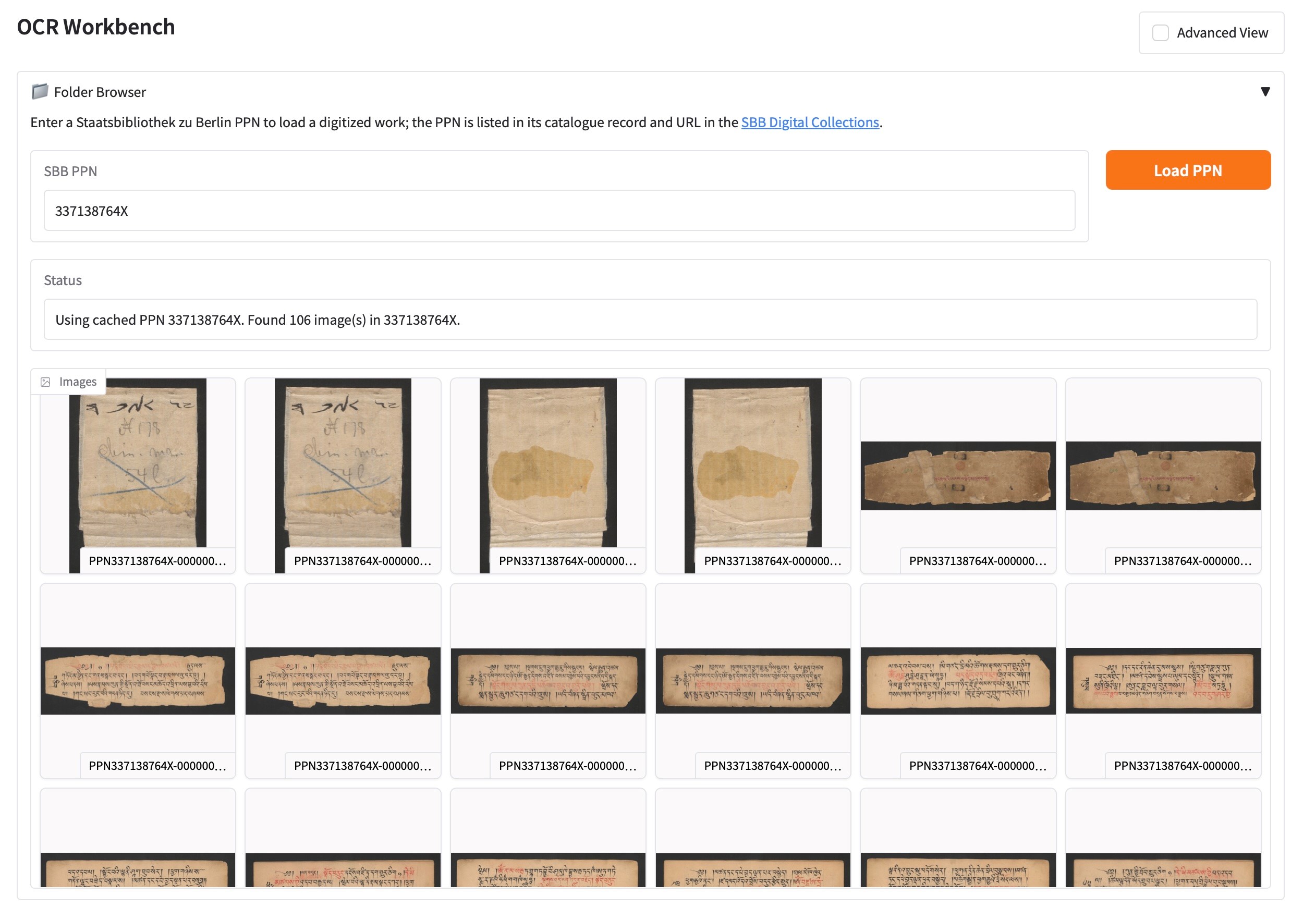
Figure 1. Loading a digitized work from the SBB Digital Collections. PechaBridge uses the PPN to retrieve the page sequence and associated metadata and presents the individual pages for selection and processing. Source images: Staatsbibliothek zu Berlin, PPN 337138764X; interface: PechaBridge.
The workflow is:
enter PPN → retrieve pages and metadata → detect text lines → run OCR → review and export
PechaBridge detects and crops individual text lines, sends them to a Tibetan OCR model, and assembles the results into a page-level transcription. The output includes a transcript, a line-detection overlay, and the information required to trace both back to the source.
An interactive OCR Workbench supports automatic processing and targeted review of individual lines or regions, helping users inspect difficult passages and segmentation errors against the scan.
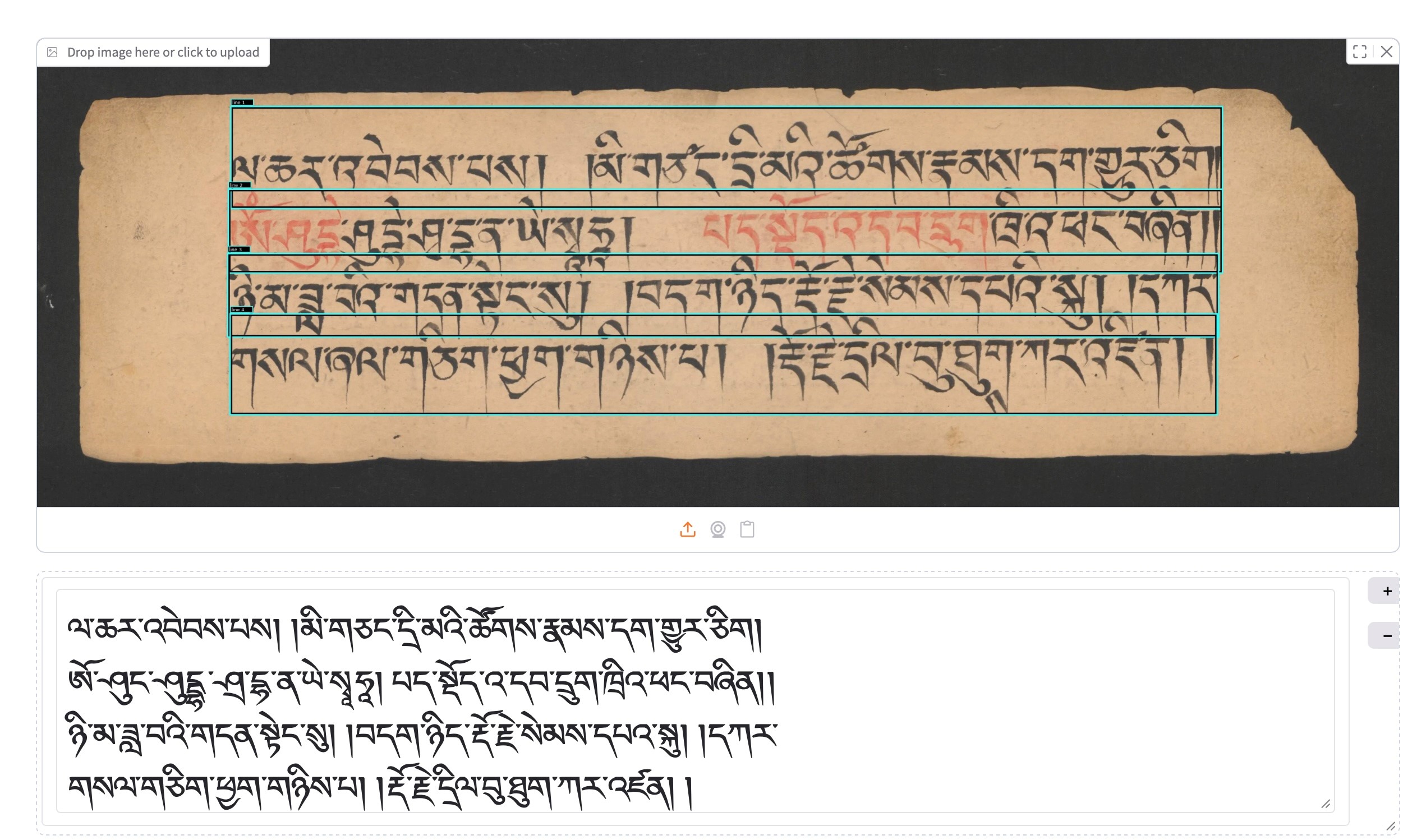
Figure 2. From page image to reviewable OCR. PechaBridge detects individual text lines and displays the resulting Tibetan transcription alongside the digitized page. The overlay makes the segmentation directly inspectable and allows the OCR output to be checked against the source. Source image: Staatsbibliothek zu Berlin, PPN 337138764X; line detection and transcription: PechaBridge.
Current Results and Challenges
In a line-level evaluation, the latest PechaBridge OCR checkpoint was tested on 3,306 pre-segmented line images from five OpenPecha data sources. It achieved a mean character error rate of 0.80 percent. Mean CER was 0.43 percent on Norbuketaka material, 1.59 percent on Google Books scans, and 1.92 percent on lines from a historical woodblock edition of the Lhasa Kanjur.
These results indicate strong recognition across several Tibetan print domains, but they evaluate segmented lines rather than complete pages. In practical use, line detection remains a major source of error: cropped, merged, incomplete, or incorrectly ordered lines can substantially affect the transcription.
Improving segmentation and evaluating the full pipeline on previously unseen collections are therefore central next steps. PechaBridge stores model and preprocessing configurations so that results can be reproduced and reviewed.
Open Infrastructure and Collaboration
PechaBridge builds on open resources from Tibetan digital humanities, including Buddhist Digital Resource Center (BDRC) and OpenPecha data and models. Its source code is available on GitHub, while its models are published through Hugging Face.
The project began with Buddhist pecha materials because suitable collections, training data, and models were available. Its modular architecture is intended to support manuscripts, archival documents, historical prints, and other Tibetan-script materials.
We are therefore interested in collaborating with libraries, archives, and researchers in Tibetan studies to evaluate PechaBridge on new collections, create reviewed benchmarks, adapt models to specific material traditions, and develop sustainable correction workflows.
Researchers and collection holders interested in a pilot project or technical exchange are invited to contact Dr. Nico Mothes through his SAXONY.ai profile.
Acknowledgements
SAXONY.ai and Cloud & Heat Technologies generously provided GPU capacity for training and evaluating the larger vision-to-text models. SAXONY.ai also supported the project with AI tools, models, and technical expertise.
PechaBridge shows how digitized Tibetan pages can become structured, verifiable, and reusable research data by connecting page images, OCR, metadata, reproducible processing, and interactive review.
Project Resources

Diskutieren Sie hierzu im CrossAsia Forum